By 2030, an estimated 1.2 billion women worldwide will be menopausal or postmenopausal, with about 47 million reaching menopause each year. These hormonal shifts, which can begin years earlier in perimenopause, can bring about a long list of changes, from sleep and mood to skin texture, firmness and hydration. Yet while conversations about these phases of life are becoming more common, the impact on our skin and appearance is still an area where many of us feel unprepared. However, key industry experts are working to change that.
The message is clear: We deserve better education about what’s happening to our skin, why it is happening and what we can do about it. For many women, skin care helps; for others, in-office treatments make a bigger impact. Either way, the first step is understanding the changes.
Ahead, experts break down the in-office treatments worth considering and the everyday habits that matter just as much.
Featured Experts
- Doris Day, MD is a board-certified dermatologist in New York
- Ellen Marmur, MD is a board-certified dermatologist in New York
- Adelle Walker is chief marketing officer for Revance
- Tara Capalbo is head of U.S. Aesthetics at Galderma
The Skin Changes Can Feel Sudden
“Usually, around 45, you’re almost by definition in perimenopause, and by around 50, you’re generally menopausal,” says New York dermatologist Ellen Marmur, MD. “You can still have your period and be hormonally menopausal. It’s not always measurable, and it’s not black-and-white science.” For many women, the first signs of perimenopause aren’t immediately recognizable as hormonal changes.
“In my own practice, what I see is women coming in and saying things like, ‘One day my face just fell apart. Why is my skin dry and itchy? Why am I breaking out like a teenager?’” says New York dermatologist Doris Day, MD. She often connects those concerns with other changes, including shifts in sleep, mood, joint discomfort and menstrual cycles, to help patients recognize that they may be experiencing perimenopause.
The lack of awareness is not simply anecdotal. In research discussed by Tara Capalbo, head of U.S. Aesthetics at Galderma, at a recent event in New York, Galderma surveyed more than 4,300 women across nine countries and five continents to better understand their experiences with menopause, skin and aesthetics. The findings suggested that many women learn about the skin changes only after experiencing them firsthand. In fact, 90 percent of women surveyed said they had never been taught about menopause.
Dr. Day believes the knowledge gap extends to medical professionals, too. “They’re not having the discussions with their doctors,” she says. “GYNs don’t seem to want to own the space. Primary care physicians don’t seem to want to have that conversation. Women are kind of told, like, ‘You’ll power through, you’ll be fine.’ And they’re not satisfied with this answer.”
For Dr. Marmur, menopause has become a regular part of her conversations with patients, many of whom are trying to make sense of several changes at once. She describes the dermatologist’s office as a place where patients can voice concerns and ask questions they may not have known how to bring up elsewhere. The goal, she says, is to make those conversations more comfortable and help patients understand their options.
A separate study from Revance found that 50 percent of perimenopausal women were not aware of how menopause would change their skin and appearance when the transition began. “We also asked them whether they would want formal health care and aesthetics in the same place, and surprisingly, 68 percent said yes,” says Adelle Walker, chief marketing officer for Revance. “When we heard that, we thought, ‘Wow, what can we do as a medical aesthetics company?’ We have great products, including regenerative treatments, injectables and skin care. How can we bring those together so women can get this care in one place?”
What’s Happening to Our Skin During Perimenopause and Menopause
Estrogen plays an important role in skin health, and hormonal changes can affect hydration, elasticity and collagen. The result can be a combination of fine lines and wrinkles, dullness, dryness and changes in firmness—not simply one isolated concern.
Dr. Day points to research showing that women can lose up to 30 percent of their collagen in the first five years after menopause, followed by an estimated 2 percent annually thereafter. “Changes are influenced by several factors, including declining estrogen, cumulative sun exposure, genetics and skin-care products that may be too aggressive for the skin’s needs,” she explains. “Those collagen-building cells—the fibroblasts—are simply exhausted and depleted. This is one reason why I focus on supporting skin quality rather than treating lines or volume changes alone. No single treatment can address every concern.”
Dr. Marmur similarly encourages women to think beyond wrinkles. “Skin texture, laxity and the appearance of the neck, chest and upper lip can become more noticeable during this stage, and these areas may not respond well to simply adding volume,” she says. In her view, a treatment plan should take the whole face—and how it moves—into account.
The In-Office Treatments That Can Help
As women learn more about the changes associated with menopause, interest is growing in treatments that focus on skin quality, not just facial volume or expression lines. “Patients often want to look refreshed without taking on significant downtime, making regenerative approaches such as microneedling part of the conversation,” Dr. Marmur says. “Everyone wants to glow, right? And that’s what they say. ‘My face is starting to look a little dull. I’m not sleeping as much. I’m taking care of other people, and I don’t have any downtime.’”
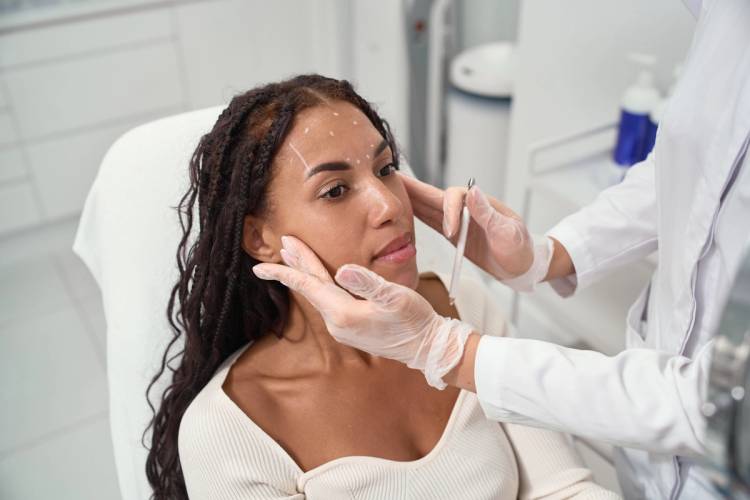
One example is SkinPen, a microneedling device. “SkinPen uses mechanical microneedling to create controlled microchannels in the skin, supporting the body’s natural regenerative processes,” says Dr. Marmur. “It can help improve the appearance of texture and dullness. The neck and the hands are amazing areas for SkinPen, in addition to the under-eyes.”
For women who are concerned about volume changes, fillers (both hyaluronic acid and biostimulatory) can help restore balance. “It’s important to choose a formulation suited to the treatment area to preserve natural movement, particularly around the mouth, where the skin is highly dynamic,” says Dr. Marmur, who is a fan of the RHA Collection of fillers: RHA Redensity, RHA 2, RHA 3 and RHA Dynamic Volume. “You need something that’s gonna move with you—a really delicate enhancer.”
Dr. Day’s approach is to support the skin’s health and structure over time. “For some patients, that might involve using a combination of neuromodulators, hyaluronic acid fillers like Restylane, microneedling and energy-based devices. For others, it may mean a collagen-stimulating treatment such as Sculptra,” she explains. “I’ve said for the longest time that my Sculptra patients are my happiest patients because they love the change in their skin texture. They love the way that it’s restoring their body’s own natural collagen.”
Capalbo says approximately 85 percent of aesthetic patients are women, so understanding how treatments perform during different stages of women’s lives is essential. “As part of Galderma’s effort to address the research gap, we’re incorporating menopausal status into our injectable aesthetics clinical trials. We’re also collaborating with dermatologists, plastic surgeons and gynecologists to develop a consensus paper intended to provide guidance on treatment approaches for women during these stages of life.”
Aesthetic Treatments Are Only One Part of the Picture
While in-office procedures may help address specific concerns, daily habits matter, too: sun protection, a consistent skin-care routine, nutrition, exercise and sleep. “Nothing looks more beautiful in your 50s than sun protection in your 20s,” says Dr. Day.
Skin changes may be part of a broader transition, so decisions about hormone therapy should be made with a health-care professional who can consider your individual symptoms and medical history. “Be careful about treating online information as a substitute for personalized care,” says Dr. Marmur.
Ultimately, the point isn’t that every woman needs aesthetic treatments, or that menopause should be approached as a problem to fix. The goal is for women to have the information and support to make choices that help them feel comfortable in their skin.
“I don’t want women to be caught off guard by menopause,” says Dr. Day. “Start learning about it in your 30s, pay attention to what’s happening in your 40s, and make these conversations part of your ongoing health care. I don’t think we become less beautiful with age. I think in many ways we become more beautiful. It’s just a different beauty. And that we have to learn to see.”