For years, anti-aging meant chasing one wrinkle or filling one hollow. At NewBeauty’s first State of Aesthetics Roundtable in New York, the doctors around the table kept coming back to something bigger: the health of the skin itself.
Jennifer Pearlman, MD is a Toronto-based physician focused on women’s health and menopause medicine, and she emphasized the connection between skin health and longevity. “We can’t talk longevity until we restore healthy, radiant skin quality,” she said. Dr. Pearlman, who attended as a guest of Artemis, also discussed the role of hormonal health and regenerative approaches in aging.
From Vanity to Longevity
That idea of skin longevity came up again and again. “The walls are coming down,” said the roundtable’s moderator, Chicago facial plastic surgeon Steve Dayan, MD. “Aesthetic medicine is no longer just aesthetic medicine; it’s combining with longevity medicines.”
San Diego dermatologist Tess Mauricio, MD also attended as a guest of Artemis. She said dermatologists now see skin as more than a cosmetic concern. “We’re looking at the skin not just as an endpoint of what is happening in the body, but actually a sign of what is happening biologically,” she said. New York dermatologist Marina Peredo, MD echoed a phrase that came up more than once during the evening: “From vanity to longevity.”
That’s driving interest in regenerative treatments, which aim to help skin repair and rebuild rather than simply cover up what’s changed.
Deeper Than the Surface
Dr. Pearlman said that thinking is changing what doctors want from energy-based treatments. The newest generation is “less about surface refinement,” she said, and more about technology that reaches deep into the tissue “to restore skin quality, like Neogen.”
Neogen comes from Artemis, whose CEO, Simon Mansell, also joined the roundtable. According to the company, it uses pure nitrogen plasma to deliver controlled heat into the deeper layers of the skin while preserving the surface. It’s FDA-cleared for concerns including wrinkles and acne scars and can treat the full face, including the eyelids. Results build over several months.
Prevention Is the New Playbook
The other big shift is timing. Austin, TX plastic surgeon Johnny Franco, MD noted that patients embraced preventive toxin years ago. “But now we’ve even seen preventative energy devices,” he said. “I’ve seen people being more proactive with their energy devices and not waiting.”
It’s a smart instinct, because collagen loss picks up speed with age and especially around menopause. Dr. Pearlman sees women’s health as one of the biggest stories in medicine right now. “Female-centric medicine is having not a moment but a paradigm shift,” she said. Preventive skin tightening can’t stop the clock, but starting before laxity sets in gives skin a stronger foundation to work from.
Building, Not Subtracting
The same philosophy is reshaping the body. Asked whether his practice is seeing more demand for body skin tightening, Dr. Franco said, “Definitely more skin tightening.” Across body procedures, he added, patients want a fit look that suits “their active lifestyle” rather than dramatic change.
Vero Beach, FL plastic surgeon Alan Durkin, MD explained why energy-based treatments appeal to so many of those patients. Many work by stimulating collagen, which makes them “more additive” than procedures that remove tissue. For Dr. Durkin, starting with noninvasive care is also how doctors build lasting relationships with patients. “Starting that early on and maintaining that, that’s part of how we earn trust before we convert to surgery,” he said.
Artemis’s T-Shape 2 is built for that kind of body skin tightening. It combines multipolar radio frequency, low-level laser, vacuum and mechanical massage in one noninvasive session to target laxity, texture and contour, with no downtime, according to the company. Dr. Mauricio called it “amazing,” and Mansell said patient demand has climbed fast. A year after Artemis launched consumer advertising for its partner practices, monthly new patients grew from about 100 to about 3,000. “The T-Shape 2 also just is an amazing device, gets amazing results,” he said.
The Combination Approach
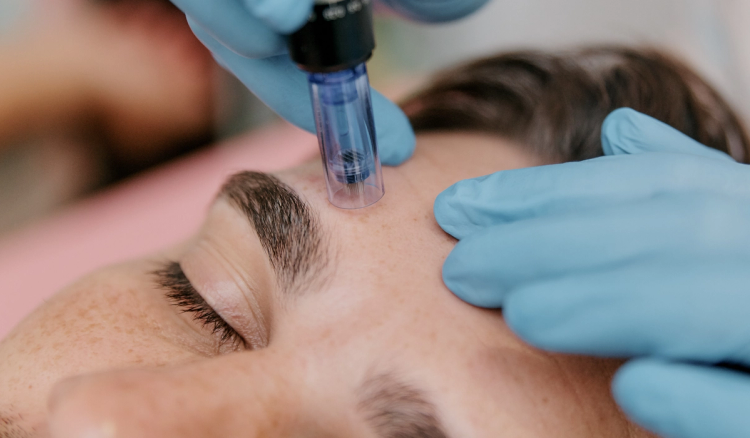
Few doctors at the table rely on a single tool. Dr. Mauricio builds plans that layer several at once. “We definitely have seen patients where they’ve been doing regenerative combination therapies, multiple types of energies,” she said. For the face, her Time Machine protocol pairs an energy treatment such as CO2 laser or RF microneedling with platelet-rich plasma and sometimes nanofat or exosomes.
What to Ask Before You Start
If skin quality is your goal, tell your provider that up front. Ask what’s driving the changes you see, whether that’s age, hormones, sun or weight shifts, and whether a plan that combines energy-based treatment with regenerative add-ons makes sense for you. Ask how many sessions you’ll need and when to expect results, since collagen takes time to build.
Credentials matter, too. “Discovery doesn’t equal trust,” Dr. Mauricio said, and patients are paying more attention to experts with “real credentials,” “real experience” and “real great technology to create incredible results.”
As Beverly Hills, CA plastic surgeon Charles Galanis, MD put it, the goal has changed. People “are realizing that they’re not coming here to look better; they want to feel better.”