
“Mommy Makeover.” The term is everywhere now, as much a part of the cultural lexicon as “quiet luxury” and “self-care.” Loosely, it’s shorthand for a tummy tuck, breast augmentation, maybe some liposuction—the post-baby holy trinity, if you will. Really, though, it’s whatever makes a mom feel like herself again, whether that’s a syringe of Botox or a full-body restoration.
But, the 2026 version has new variables: GLP-1s, creating a population navigating skin laxity after major weight loss; social media, where before-and-afters, recovery diaries and AI-altered ideals compete for attention; and medspas, multiplying like Starbucks and hawking Groupon-adjacent versions of surgery. The result is more treatment options, more nuance and a very different makeover than your mother’s.
A Very 2000s Origin Story
“Mommy Makeover” entered the chat in the early-to-mid 2000s, as cosmetic surgery boomed and reality TV found its own appetite for transformation. Exhibit A: Fox’s The Swan, which, in 2004, put contestants through roughly 10 procedures apiece, building to a pageant-style reveal. Many of its “ugly ducklings”—the show’s nickname for its participants—were mothers unhappy with their post-pregnancy bodies.
The term itself is seemingly impossible to pin down; nary a soul on the big old internet claims to be the first to use it. “Mommy Makeover” was never official, just a nickname that caught on and stuck. Twee as it is, the procedures behind it kept climbing: By 2010, tummy tucks were up 85 percent since 2000 and breast lifts increased 70 percent, per the American Society of Plastic Surgeons (ASPS). Breast augmentation, meanwhile, had already jumped 55 percent by 2006 alone. Two decades later, the demand hasn’t faded.
The New Rules of the Makeover
The goal hasn’t changed: Look and feel your best. But the how has evolved considerably. “There have been more innovations in body contouring over the past 10 years than the prior 20,” says Dallas plastic surgeon Jeffrey M. Kenkel, MD.
Precision, above all, is reshaping body contouring at large. “The extremes have fallen,” Dr. Kenkel notes—the BBL, once cosmetic surgery’s boldest statement, has given way to subtler, more sculptural results. That same restraint now defines the mommy makeover: muscle etching, which uses liposuction to carve definition instead of just removing fat; rib contouring, which narrows the waist by shaving down the ribs themselves; and fat grafting, which moves fat from one area to another to build contour, not just erase it.
That same logic—build, don’t just remove—applies above the waist, too. “More women are interested in breast lifts without adding implants,” says New York plastic surgeon Oren Tepper, MD, who repositions and reshapes the breast’s own tissue rather than adding volume with an implant. The same precision shows up at the face, where fat grafted from elsewhere on the body can fill a cheek, a temple or the soft spot under an eye.
The numbers back up the experts, too. Five procedures commonly grouped under “Mommy Makeover”—tummy tuck, breast lift, liposuction, breast reduction, lower bodylift—added up to more than 762,000 surgeries in 2024, per the ASPS. Tellingly, breast augmentation is the outlier: the only one built around adding rather than restoring. It grew just 5 percent over 20 years, versus 27 to 83 percent for everything else, which is further proof that restoration, not addition, is driving the boom.
All of this to say: Bigger isn’t the goal, and neither is less. It’s about getting back what’s yours. Which leaves one question: When?
The Timing: Motherhood Edition
If Your Family Is Still Growing: Not every procedure has to wait for the last baby. “A breast lift without implants doesn’t take away the option of getting implants later, once someone’s finished having children,” says Dr. Tepper. (Meaning, treatment can be staged rather than saved for one definitive overhaul.) Facial work is even less tied to pregnancy timing: Fat grafting and mini facelifts aren’t affected by future pregnancy plans at all.
Surgery, though, is a different story. If another pregnancy is imminent, “I do think deferring can be the right decision,” says Dr. Tepper. The body isn’t finished changing yet, and a second round of changes can mean another round in the operating room.
If You’re Losing Weight on a GLP-1 : Weight loss on a GLP-1 happens fast, but surgery, deliberately, does not. New York plastic surgeon David Shafer, MD waits until a patient’s weight has stopped changing before operating, then builds the plan around what the weight loss left behind. Loose skin can be treated with tightening technologies such as Renuvion, Density RF, Genius RF or a CO2 laser, sometimes alongside surgery. Patients more concerned with muscle tone may turn to CoolTone, a nonsurgical, muscle-stimulating treatment.
Volume loss after weight change is a different issue. For patients without enough fat left to graft, Dr. Shafer often utilizes alloClae, an off-the-shelf fat-grafting product, to restore volume, plus dermaClae, a similar filler-based product, for smaller, more targeted areas.
If You’re Done Having Kids: Once future pregnancies are off the table, bigger, more definitive procedures start to make sense. But, that doesn’t mean doing everything at once. Dr. Shafer describes it as “a customized approach tailored to each patient’s specific anatomy and procedural expectations.” Increasingly, that means a “mini” version—selective surgical contouring paired with minimally invasive tools like AYON with Renuvion, Density RF, alloClae, neurotoxins and fillers.
Science > Social Media
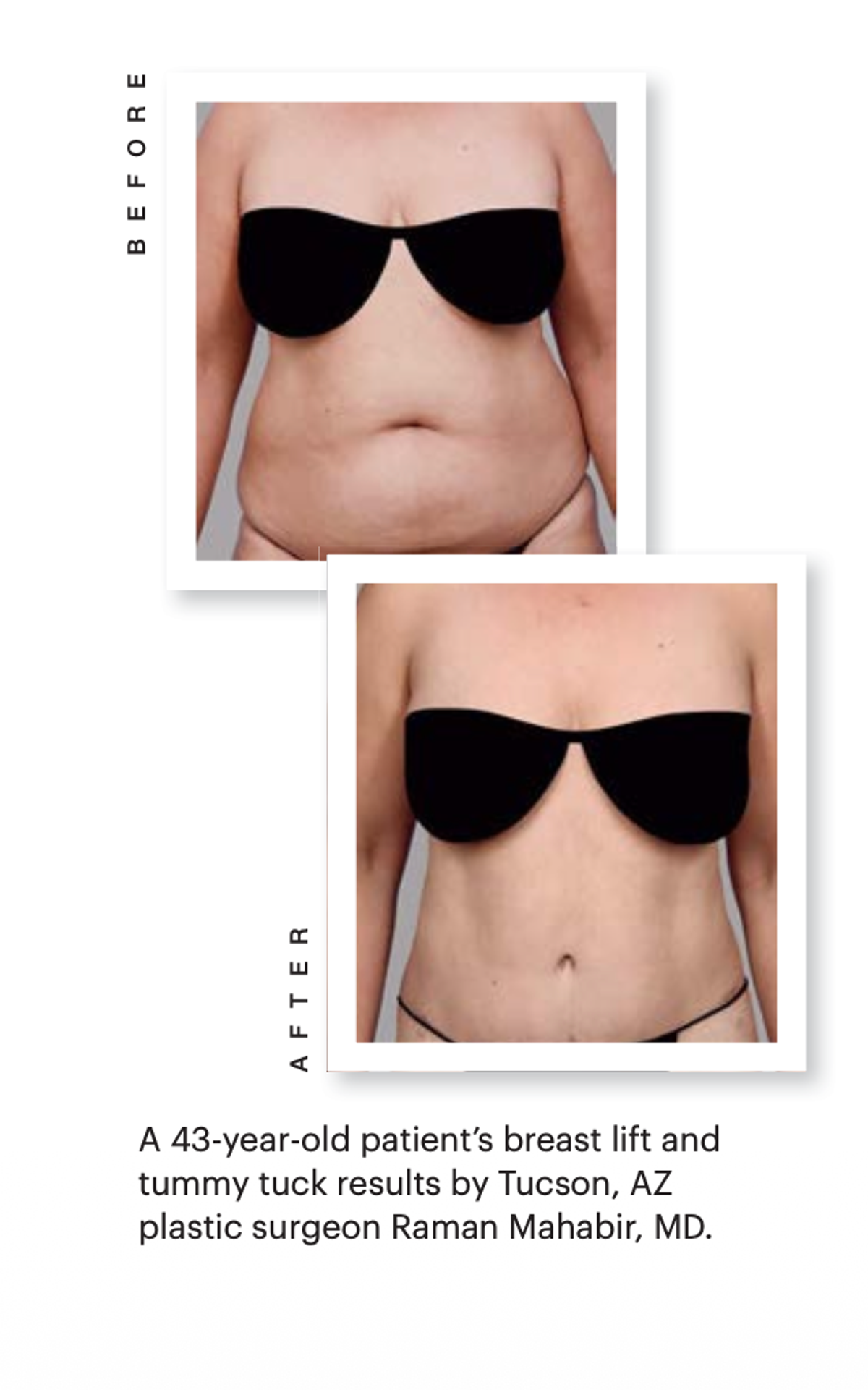
“Social media and AI-altered images have raised the bar for what patients expect,” Dr. Shafer says. His fix: real before-and-afters, “so they understand what is achievable and natural rather than artificially filtered perfection.” The after is what makes it to Instagram; the swelling, bruising and downtime don’t. “Patients also often don’t understand what happens between surgery and the ‘after’ picture,” he continues, “so we spend time counseling them on realistic expectations for recovery.”
Even content creators are aware of that educational white space. Alexa Booth, mom of six and avid TikToker with nearly 200,000 followers, documented her Mommy Makeover on her platform and has continued posting about it since. Before booking, she searched TikTok for other creators’ experiences, but found most people skipped over the difficult stuff. “I mostly saw the dramatic before-and-afters, but no one explained how you would feel on a day-to-day basis—how my body would change so much every week due to swelling, and that was normal,” she tells us. “Or, how results take a good six to 12 months to see the final look.”
That gap is exactly why she started posting. “A Mommy Makeover is a major surgery, and I want others considering this procedure to know what to truly expect—not just the highlight reels and dramatic transformations. There are lots of ups and downs, and it’s OK to feel all the emotions during such a major recovery.” She has no regrets, she says—she just believes you can never be too prepared.
Popularity Isn’t a Credential
The feed doesn’t just distort outcomes; it distorts who’s qualified to deliver them. A 2017 analysis of nearly 1.8 million plastic surgery–tagged Instagram posts found that just 17.8 percent of top posts came from plastic surgeons eligible for membership in the Aesthetic Society; two thirds of the top content was promotional, not educational.
Social media makes a Mommy Makeover look nearly as casual as a blowout. Dr. Kenkel insists the science says otherwise. “I believe the research is definitely keeping up,” he says, pointing to higher procedure volumes and more credible publications validating outcomes and risk. What hasn’t kept up is how patients read the internet’s version of proof. “More likes does not imply a better surgeon, better outcomes or lower risk,” he warns. It’s a problem he sees worsening, particularly for commodity procedures like lipo and breast augmentation.
His advice is just as unglamorous: “Patients need to do their homework on providers, ensuring their board certification in plastic surgery and their experience with any one procedure.” Getting a few opinions matters too, he says, because there are many ways to do any given procedure, and personality counts as much as pedigree. “Patients should find the personality and qualifications that make them most comfortable.” Trust your gut, in other words, but only after you’ve checked their credentials.