Wellness culture has found its latest obsession—fiber. And not your grandmother’s bran muffin version. It’s Korean “cutting” jellies backed by Kylie Jenner, gummies fronted by Alix Earle and an entire TikTok subculture built around counting grams. But beneath the trendiness are the real questions: What is fiber, exactly? Which foods have it? And is the hype deserved?
To answer the last one first: yes—even the algorithm agrees. Per trend analytics platform Spate, fiber content is up nearly 300 percent year-over-year on Instagram, and fiber-forward drinks have surged more than 430 percent in overall popularity, largely fueled by TikTok creators.
Fiber’s wellness glow-up may be recent, but the science isn’t. A plant-based carbohydrate, fiber helps regulate digestion and blood sugar, explains board-certified holistic nutritionist Jennifer Hanway. “It creates more stable energy and reduces the physiological drive to eat every few hours,” she says.
The catch: Fiber isn’t one-size-fits-all. “Soluble fibers, like psyllium, chia and oat, tend to be gentler and better for blood sugar control, while insoluble fibers like wheat bran add bulk but can feel harsher if you’re not used to them,” Hanway explains.
But people aren’t here for the science; they’re here to buy. Enter Alan Lin, founder of Liquid+ and better known to his 200,000 followers as “Fiber Daddy.” He’s not a doctor or dietitian, but he’s built real trust by making an unglamorous topic approachable—and his flagship product, Liquid Salad, has the packaging to prove even fiber can look cool now.
Appetite for Control
Beneath the wellness branding is a very specific fantasy: a gut that behaves.
In the ’90s—fiber’s last moment in the spotlight, if you can call it that—it lived quietly, rarely discussed over cocktails. “It was associated with chalky orange drinks hidden in your grandparents’ medicine cabinet,” says Katie Wilson, cofounder of gut-health brand BelliWelli. This time, fiber isn’t just visible—it’s sold as proof you have your life together.
Now, people want fiber that feels “modern and lifestyle-driven,” Wilson says. And Spate’s data backs her up: The format everyone’s chasing is “routine-friendly.” On TikTok, that means “loaded water” (fiber and electrolytes stirred into a glass) and the “internal shower” (a chia-and-citrus debloating fix)—DIY rituals turning fiber into less a product than a routine.
Wilson is hardly alone in giving fiber a glow-up. Lin, the Liquid Salad creator, is part of the same wave—and so, apparently, is Jenner, whose TikTok endorsement of Foodology’s “cutting jelly” pulled over 21 million views. The pomegranate-flavored snack resembles what might happen if Jell-O and beef jerky had a wellness-era baby—slightly bizarre, unmistakably algorithm-friendly. Earle, for her part, fronted a sponsored push for Physician’s Choice—one of the category’s fastest-growing brands, per Spate, with a 293,000-plus jump in year-over-year interest.
But beneath the glossy packaging is real anxiety. Fiber is increasingly tied to conversations about colon cancer, PCOS and hemorrhoids, per Spate. In one case, that anxiety tracks with a real trend: Colorectal cancer rates in adults under 50 continue to climb by roughly 3 percent annually. And where there’s worry, there’s usually a product waiting to meet it.
The Fiber Economy
As consumers chase better digestion, brands are racing to meet the demand.
The global dietary fiber market—worth roughly $8 billion in 2023—is projected to hit $15 billion by 2030. Per the new 2025–2030 Dietary Guidelines for Americans, adults should be getting somewhere between 28 and 34 grams of fiber a day, depending on age and sex. Fewer than 10 percent of us actually do.
That disconnect created an opening for founders like Lin. “I’ve been into health and wellness for about a decade, and I’ve followed the same path a lot of people have—paleo to keto to carnivore, and now landing somewhere more about balance,” he says. “I tried carnivore and it worked in some ways, but it wasn’t sustainable. Reintroducing vegetables was a turning point—when I was eating more fiber, I felt fuller and overate less. That’s what stuck.”
Meanwhile, brands like BelliWelli and Ponlu and Sakara Life are repackaging digestive health for the internet era; glossy and TikTok-ready, branding included. But old-school names are still cashing in too: Benefiber posted one of the category’s largest absolute year-over-year gains, while MiraLAX’s growth topped 1,000 percent. Grandma’s medicine cabinet, it turns out, was ahead of its time.
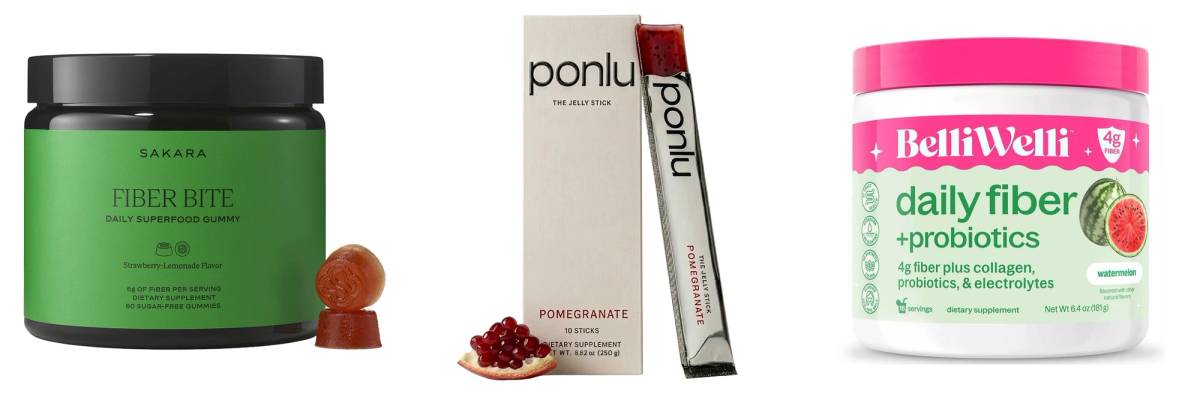
Left to right: Sakara Fiber Bite (sold out); Ponlu The Jelly Stick ($32 for 10 sticks); BelliWelli Daily Fiber + Probiotics ($20 for 16 servings)
More Than a Gram Count
Fiber awareness is up. But actual intake? Not so much.
So is this fiber obsession actually making us healthier? Awareness is growing—73 percent of Americans believe fiber is good for their health, according to a 2026 International Food Information Council survey. Whether that translates into better eating habits is murkier.
Even the brands fueling the trend are careful not to oversell it. “When you’re eating a diverse, plant-rich diet, the fiber follows,” says Danielle Duboise, cofounder of Sakara Life. “The powders and gummies are there for the days when life happens and meals don’t.”
Still, for all the “fibermaxxing” online, Americans consume roughly the same amount of fiber as decades ago. Federal dietary data shows average intake still hovers around 15 to 16 grams a day, which is well below recommended levels. To Duboise, that disconnect reflects a wellness culture that can tip into “anti-nourishment,” reducing food to isolated nutrients and optimization goals instead of actual eating. Turns out, counting grams isn’t the same as eating a vegetable.
Reality Bites
For all the hype, the fundamentals of fiber haven’t changed.
For all the powders, gummies and gut-health rituals online, the least glamorous version of fiber may also be the most effective. Hanway recommends starting with whole-food sources first—nonstarchy vegetables, berries and small amounts of properly prepared legumes. “These provide fiber, as well as water and other nutrients, which makes them easier to digest than more concentrated supplements.”
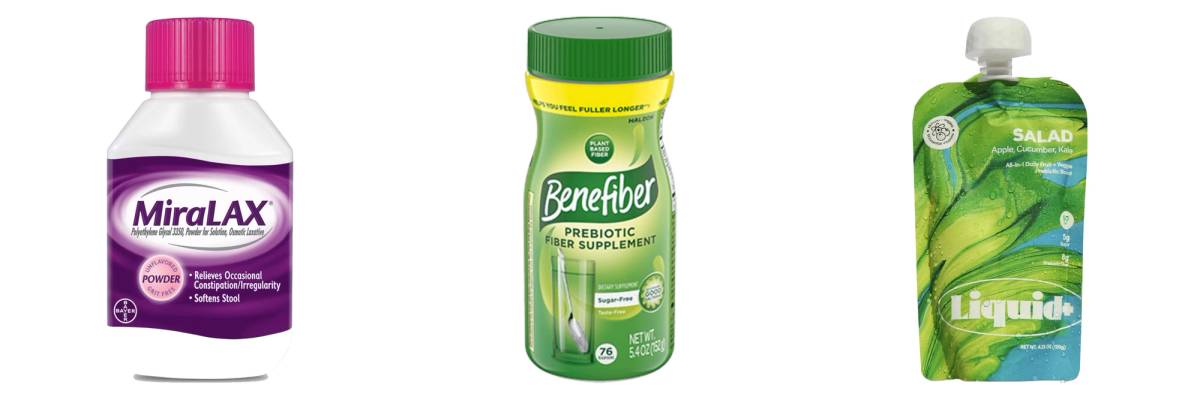
Left to right: MiraLAX ($14 for 14 doses); Benefiber ($10 for 38 servings); Liquid Salad by Liquid+ ($70 for 28 pouches)
That doesn’t mean supplements are off the table entirely. “If you’re adding a supplement, increase gradually—your gut needs time to adjust,” Hanway says. “Start with 5 to 10 grams additional per day and assess your tolerance before increasing further.” Her biggest piece of advice has less to do with fiber than with patience—the one thing the algorithm has never been good at selling.
The internet, in other words, turned fiber into a personality trait. Unfortunately for the algorithm, the science still points back to the vegetables. Grandma, once again, was right.