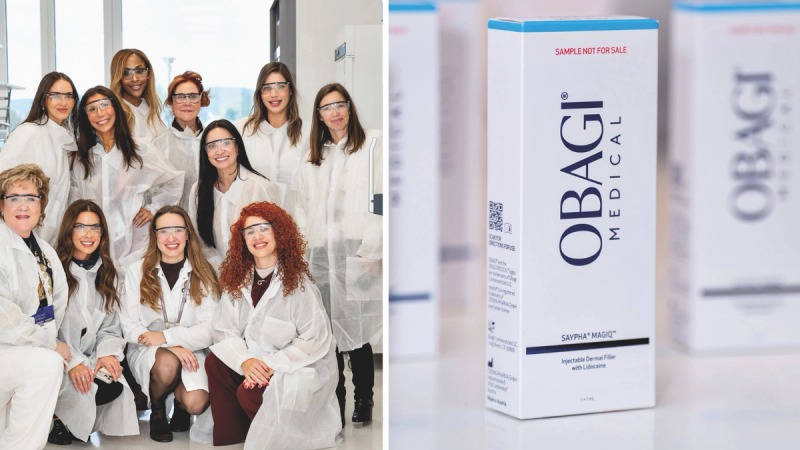
I’ve spent more than a decade reporting on injectables, and almost as long incorporating them into my own routine, but until Obagi Medical invited me to Vienna for a look inside Croma-Pharma, the Austrian manufacturer behind its newest FDA-approved fillers, MagIQ and ChIQ, I had never seen—up close and personal—how filler is made. The process, I would learn, was a meticulous, tightly controlled operation with a level of quality control I never could have imagined.
Here’s an inside look at my visit, alongside some of the country’s most respected dermatologists, plastic surgeons, aesthetic physicians and expert injectors.
Featured Experts
- Valentin Gruber, director of global marketing and customer experience at Croma-Pharma
- Drew Fine, U.S. general manager, professional channel, Obagi Medical
- Konstantin Frank, MD, facial plastic surgeon in Munich
The Backstory
Croma was originally a family-owned pharmaceutical company, founded in 1976 in the back room of a Vienna pharmacy by two pharmacists. “The pharmacy is still run by our founding family in the city center,” explained Valentin Gruber, director of global marketing and customer experience at Croma-Pharma. The company’s early expertise in pharmaceutical-grade hyaluronic acid for ophthalmology, including cataract surgery, laid the foundation for the aesthetic injectables it began manufacturing in 2009.
MagIQ and ChIQ may be new to the United States, but the hyaluronic acid (HA) filler technology has been used around the world for years under Croma’s Saypha portfolio. For Obagi, the partnership helps the brand expand its skin-first approach into injectables, pairing fillers with Obagi’s existing skin-care portfolio. “We aim to build Obagi into a leading professional skin health company, and the partnership with MagIQ and ChIQ is an important step in expanding how we serve providers and consumers,” said Drew Fine, U.S. general manager, professional channel.
Inside the Lab
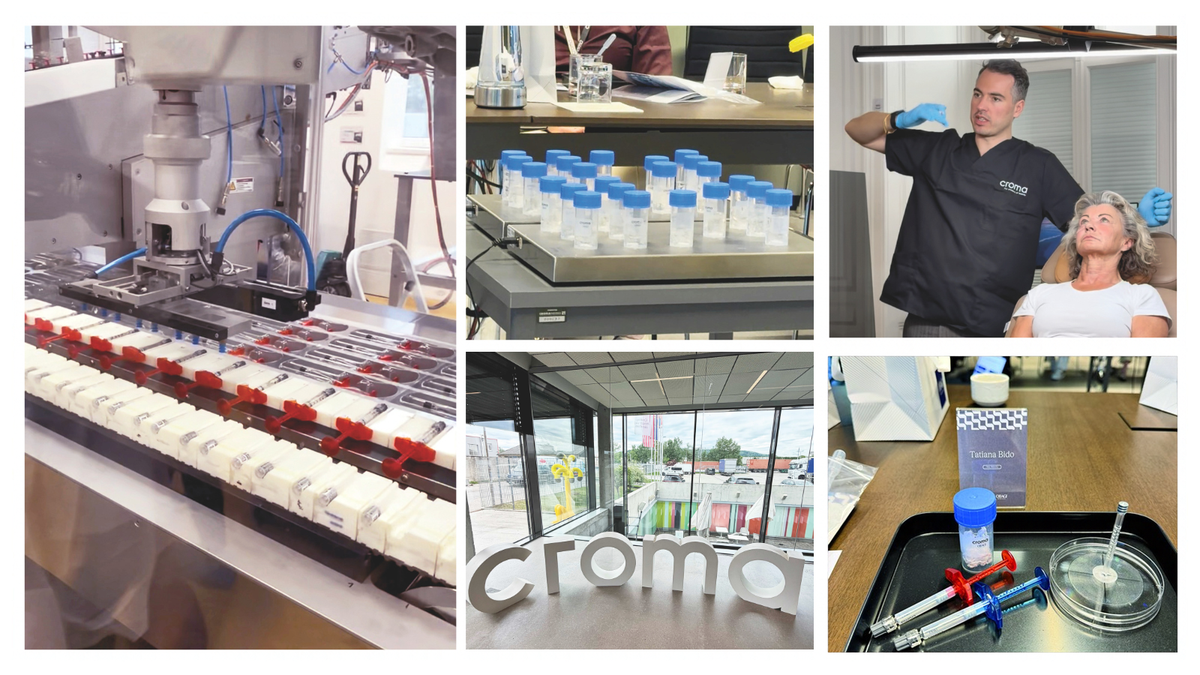
Walking through the Croma production facility, the first thing that struck me was how carefully the product is handled throughout the manufacturing process. Five needles work simultaneously within a sealed filling system, producing roughly 5,000 syringes an hour. Technicians only access the machinery if there is a malfunction, and even then, they work through gloves built directly into the enclosed equipment. One production barrel yields approximately 80,000 syringes.
What stayed with me more than the numbers was the attention paid to each individual syringe. After they are filled, every single syringe—not just a sample—gets visually inspected by hand under a rotating, illuminated magnifier and checked for any imperfections like cracks in the glass. Inspectors rotate off the task every 25 minutes to prevent eye fatigue. The production line operates inside a Class C–certified clean room, with the most critical zones—like the filling point—engineered to Class A conditions, which is the highest standard of air cleanliness in pharmaceutical manufacturing. Throughout the line, air is continuously filtered and replaced to maintain these strict cleanliness levels.

Quality Control
Upstairs, the quality-control lab tests finished product, raw materials, water and equipment before any batch is released. Croma performs more than 21,000 tests a year, measuring everything from water purity to the exact force it takes to push gel through a needle. Every test generates documentation that the company is required, in some instances, to maintain for up to 20 years.
The science also explains why fillers that may look similar on paper can behave differently in an injector’s hands. Croma’s proprietary MACRO Core Technology brings hyaluronic acid chains to a more consistent length before they’re cross-linked into a gel. “The composition is very distinct from other brands,” said Munich facial plastic surgeon Konstantin Frank, MD, who has worked with Croma for more than a decade. That consistency, he explained, is what allows the gel to perform predictably from one treatment to the next.
Standing in the lab, surrounded by rows of testing equipment, I realized how rarely we talk about this side of injectables. As an editor covering aesthetics, I’m often invited to product launches and treatment demonstrations, but I never get to see the months of testing, manufacturing and documentation that happen long before a syringe reaches a physician’s hands.
Beyond the Syringe
Our most candid conversations happened after we left the lab, when the physicians began discussing the current state of fillers. “Complications are one of the main reasons why people are becoming afraid of hyaluronic acid fillers right now,” Dr. Frank said. “But most of the time, it’s not the fault of the HA; it’s the wrong application of it.”
We ended the tour with a hands-on workshop, where we mixed raw hyaluronic acid into a gel ourselves to better understand how its composition influences stability, texture and performance. Before it’s hydrated, raw hyaluronic acid looks almost like wispy strands of cotton candy. After mixing it with water, giving it a vigorous shake and enlisting the help of a vibration plate, we watched it transform into a smooth HA gel.
The next day, we watched Dr. Frank demonstrate MagIQ and ChIQ in live patient treatments, bringing everything we’d learned in the lab into practice. It reinforced what I’d seen throughout the tour: The filler itself is only part of the equation. Anatomy, patient selectionand technique matter just as much. As Dr. Frank put it, “You’ll never get a great result if you only work on the structure, or on the surface. It needs to be in balance.”
More than anything, this unique visit reinforced that while great injectables may begin in an airtight, quality-controlled factory, great results don’t end there. They’re the product of meticulous science and the expertise of the person holding the syringe.
A Parting Memento
Of everything I brought home from the trip, the most memorable wasn’t the official-looking certificate of completion Dr. Frank gave us for completing Croma’s filler education program. It was the vial of hyaluronic acid gel we made ourselves. It still sits on my nightstand, and every so often I turn it in the light, watching the crystal-clear gel slowly move inside. Now, every time I see a syringe, I think about everything it took to get there.