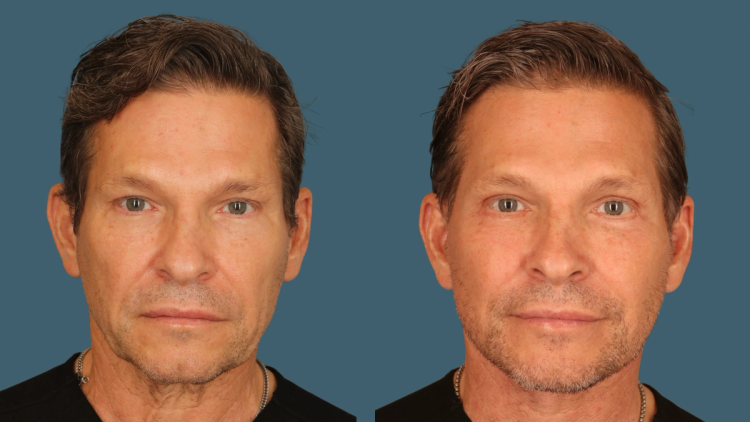

There’s a strange kind of discomfort that comes from watching a face that doesn’t move. You catch it in the middle of a pivotal scene—the moment an actor is supposed to break, or rage or fall apart, but instead, you see stillness. A forehead that won’t furrow; eyes that widen, but never quite crease at the corners. It’s subtle enough that you might not name it right away, but you feel the disconnect: Something that should land emotionally just doesn’t. As neurotoxins, fillers and other treatments have become as routine as concealer for many performers, we’ve adapted to a kind of frozen expression on screen, and in doing so, we may be losing something essential to what makes acting, acting.
I remember feeling struck by the performances in Wicked: For Good in a way I hadn’t been in some time. Upon reflection, I quickly realized it was because the leads’ foreheads weren’t frozen in one expression. Jonathan Bailey’s brow furrowed when flexed, and Ariana Grande’s 11 lines were the focal point of some of her most star-making moments (she's been vocal about stopping neurotoxins). This is, of course, not to say they don’t have toxin in some spots and other work done, but it was refreshing to see faces on screen that actually reacted and felt like human faces.
It’s invigorating to watch a scene from The Bear that doesn‘t shy away from Jeremy Allen White’s static wrinkles or take in a close-up of Molly Gordon’s errant brow hairs. When I think of the most memorable performances over the past few years, stars like Kate Winslet, Paul Mescal, Viola Davis, Robert Pattinson, Colman Domingo and Jamie Lee Curtis come to mind. The common factor? They look and feel like real people. Their faces move.
A frozen face makes for a frigid audience
Certain aesthetic treatments can, when overdone or done incorrectly, limit actors’ muscle movement, flattening micro-expressions and making it difficult to convey intense emotions convincingly. This creates a barrier between the performer and the audience, reducing emotional immersion. Olivia Wilde recently told Vogue “as a director, I now am constantly searching for actresses who can still move their faces, and it’s not easy.”
Clinical psychologist Dr. Chloe Carmichael says, “Facial micro-expressions—unconscious, fleeting facial movements lasting only a fraction of a second—are the bedrock of subconscious human communication. Audiences connect with performance through automatic ‘facial mimicry’ and mirror neurons. When a viewer observes subtle shifts in an actor’s face, such as a slight tightening around the eyes or a momentary twitch of the lip, their brain subtly mirrors those movements, generating a corresponding emotional response.”
Additionally, micro-expressions register as involuntary, making them signals of genuine emotion, says Dr. Carmichael. “When macro-expressions, like a full smile or cry, are not supported by natural-looking micro-movements, the audience senses a discrepancy,” she explains. “This ‘uncanny valley’ effect makes a performance feel forced, guarded or flat, preventing the audience from fully suspending disbelief.”
Societal pressure plays a part
The conundrum for many actors today is how to balance the scrutiny of the public eye with the ability to perform their craft to the best of their abilities. Social media and tabloids are rife with critiques of celebrities’ appearances, from the lines that age them to the under-eye bags that make them look tired, so naturally they seek a solution. However, that solution may in turn impair their acting abilities, bringing on a fresh layer of scrutiny. Wilde told Vogue that while it’s frustrating as a director she understands it as a public figure. “I am a product of the same machine,” she continued. “I am under the same pressures. I get it.”
Striking a balance
Actors and non-actors alike often want to maintain a youthful, healthy look without appearing as though they've had work done, explains Beverly Hills, CA facial plastic surgeon Paul S. Nassif, MD. “That can be achieved while preserving the subtle movements needed to communicate emotion on camera,” he says. “For an actor, I evaluate the face in motion, not just in a still photograph. I want to understand which expressions are essential to that individual’s work and which lines or movements may actually be part of their identity on camera.”
Scottsdale, AZ facial plastic surgeon Kelly Bomer, MD says actors should be very careful when seeking aesthetic improvements and select their doctors carefully. “The most important advice I would give is to move slowly and don’t do anything irreversible without serious consideration beforehand.”
The freeze factor
Neurotoxin injections, like Botox Cosmetic, Dysport and Xeomin, tend to get the worst reputation when it comes to masking emotions, although facelifts are a close second. “Neurotoxin is typically used to reduce the strength of or freeze the muscles between the eyebrows that convey worry and anger, as well as the muscles that raise the eyebrows that can convey surprise and wonderment,” says Dr. Bomer. “When these muscles aren’t moving, less emotion is conveyed.”
However, when carefully done by an expert, the ability to emote doesn’t have to go out the door with your wrinkles. “By artfully reducing the amount of neurotoxin injected, one can soften extreme expressions and improve overall beauty, but maintain the ability to convey strong emotions,” Dr. Bomer adds.
Dr. Nassif says that the muscles most commonly treated with neurotoxins “all contribute to facial movement and the visual cues used to communicate emotion. Treating them requires a precise understanding of facial anatomy, muscle balance and the patient’s natural expressions. The goal should be to soften excessive contraction without unnecessarily eliminating meaningful movement.” Dr. Bomer adds that the key is artfully and expertly injecting neurotoxins to soften extreme expressions without removing them completely.
Choosing the right treatment
Neurotoxins are only one part of the equation. Dr. Nassif says that looking refreshed does not require eliminating every single line. “A conservative, highly targeted treatment may soften certain expression lines while leaving other areas untreated so the patient can maintain natural movement,” he explains. “We can also improve how youthful and healthy someone appears by addressing facial balance, volume loss, skin texture and tone, hydration, eyelid aging, brow position or tissue descent. Depending on the patient, the right treatment may involve injectables, fat grafting, lasers, resurfacing, surgery or a combination of approaches.”
Nonetheless, it’s important to note that “any treatment that changes facial shape, support, proportion, position or mobility can influence how emotion is expressed or interpreted,” Dr. Nassif says. On the other hand, he explains that treatments that primarily address skin quality, such as lasers, chemical peels and microneedling, generally have much less direct impact on muscular expression. Dr. Levine adds that lasers can help improve the tone and texture of the skin, while fillers can lift and volumize without affecting expressions.
Additionally, fillers and fat grafting may restore lost structure and volume without intentionally weakening the muscles, says Dr. Nassif. “While fillers don’t directly weaken muscles, excessive volume or poor placement, particularly around the lips, cheeks or under-eye area, can alter the way a smile or other facial expression looks,” he explains. “Fat grafting can also influence expression. It restores volume rather than weakening muscle, and when it is conservatively placed in the appropriate anatomical areas, it can produce a very natural result that moves with the face.”
Procedures such as browlifts, eyelid surgery, facelifts, necklifts and thread lifts can influence the resting position and dynamic appearance of facial features as well. “What matters is selecting the appropriate operation for the patient, avoiding excessive skin tension, protecting the facial nerve and repositioning the deeper tissues without distorting the patient’s identity,” Dr. Nassif explains. “The wrong approach can make someone appear surprised, tired, angry or emotionally disconnected.”
New York dermatologist Jody A. Levine, MD says the great actors she's treated “have been able to strike the right balance of aging minimally and beautifully while still being able to animate. Some of that has to do with nuanced neurotoxins, some of that has to do with discrete fillers, and some of that has to do with well-timed and appropriate lasers.” Dr. Levine notes that her husband, New York plastic surgeon Elie Levine, MD, who operates on many A-listers, has a similar ethos. “The idea is to use combination therapy in a way that preserves someone’s natural beauty while also making them look younger and more attractive,” says Dr. Jody Levine.
“Ultimately, the best result allows the patient to look like the healthiest, most refreshed version of themselves, not a different person,” says Dr. Nassif. “If the treatment is obvious or interferes with their ability to convey emotion, then we missed the mark.”