Ask patients what they want and, according to New York maxillofacial surgeon Yan Trokel, MD, nearly all of them make the same gesture. Over Zoom, he shows us: hands on the cheeks, pushing up, not out. “They want to be lifted,” he says. Until recently, that meant a facelift for those open to surgery or a thread lift for those who weren’t. The “Y Loop” offers a third option. It’s a minimally invasive suture technique from Dr. Trokel, who also created the “Y Lift,” a filler-based alternative to a facelift.
Ahead, what the Y Loop and Y Lift are, how the Loop differs from threads, how the two work together and where to get it.
Why do faces lose their lift?
According to Dr. Trokel, two things happen as we age. “Number one is we have volume loss,” he says. “The second part is descent of tissue, meaning, you know, the face just falls.” As volume (and the bone beneath it) recedes and the ligaments holding everything in place loosen, the tissue on top starts to slide.
Surgeons can address both with a facelift, filler, fat or some mix of the three. Nonsurgical providers have mostly had filler, and relying on volume alone to fix sagging can backfire. (“That’s how faces end up looking really weird,” Dr. Trokel says, candidly.)
For lift, the main option has been threads: usually dissolvable sutures, often barbed, that are slipped under the skin with a needle and pulled taut to hoist sagging tissue. (For a broader look at the category, see our guide to the different types of thread lifts.) They’re divisive, though. Results tend to be subtle and fade within a year or two, and side effects like puckering, dimpling or threads you can see or feel under the skin are common enough that many surgeons remain skeptical. That leaves many patients with limited nonsurgical options for addressing both concerns.
What is the Y Loop?
According to Dr. Trokel, the Y Loop is a suture technique that repositions the face’s fat pads rather than adding volume to them. He uses special needles to pass a suture through the skin, then ties it to hold the tissue in its lifted position, much like a surgical purse string. “You’ve seen a purse that opens and closes with a loop, and when you pull it, it closes,” he explains. “It’s the same idea, except you’re going through the skin.”
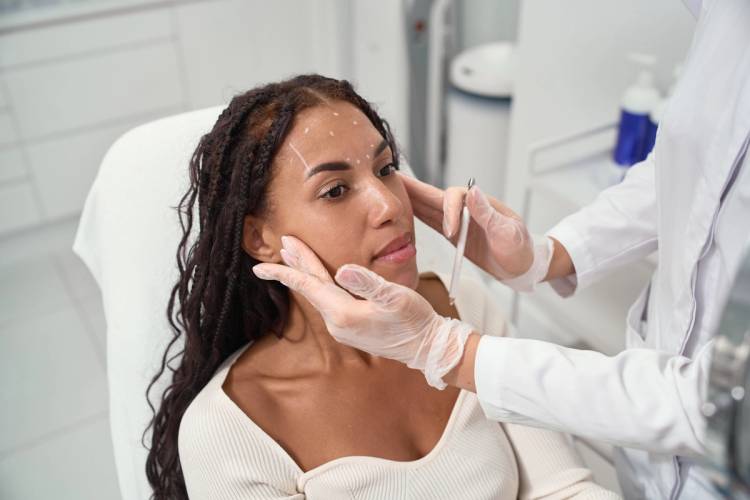
Take Zoe, one of his patients, who had considered a traditional facelift before choosing the Y Loop. In her pre-procedure consultation, shown below, he explains that the goal is to support the deeper tissues of the face, not just the skin.
How is it different from threads?
Dr. Trokel’s issue with threads is where they pull. “The reason the face falls is what’s happening underneath,” he says. “That’s where threads got it wrong, because all they did was pull the skin up in one vector.” He’s blunt about the comparison: “Threads don’t work. This is suturing.” Still, it’s too early to say how the Y Loop compares over time, since there isn’t yet long-term data on how well its results last.
How does it work with the Y Lift?
The Y Lift is a separate procedure from the Y Loop, and it addresses the other half of the aging equation. The Y Loop repositions tissue but doesn’t add volume. The Y Lift, the technique Dr. Trokel is best known for, uses filler to replace lost volume. “The Y Lift is a technique I developed that places filler on the bone in a certain way, so it looks like you’ve put in implants, like cheek or jawline implants,” he explains. “It doesn’t give you a big face, it gives you a structured face.”
At a high level, a blunt titanium cannula is inserted beneath the skin and muscle to create a pocket between the soft tissue and bone, and hyaluronic acid filler is injected into that pocket to mimic lost bone. Dr. Trokel’s website describes it as a 30- to 45-minute procedure with results that typically last two to four years.
Together, the two cover both sides of facial aging: the Y Lift rebuilds structure, and the Y Loop lifts the tissue that has slid down.
Where can you get the Y Loop, and who should do it?
Dr. Trokel performs both the Y Loop and the Y Lift at his practice. Because both involve working beneath the skin, near muscle, fat pads and blood vessels, who performs them matters as much as the technique itself. Look for a board-certified plastic surgeon, facial plastic surgeon, oculoplastic surgeon or dermatologist with specific training in the procedure you want. Ask how they were trained, how many times they’ve performed it and to see before-and-after photos of their own patients. It’s also worth asking about risks and how they handle complications.
Dr. Trokel will present the Y Loop to medical professionals at VASTOZ, an aesthetic medicine conference, November 13–14 in New York.