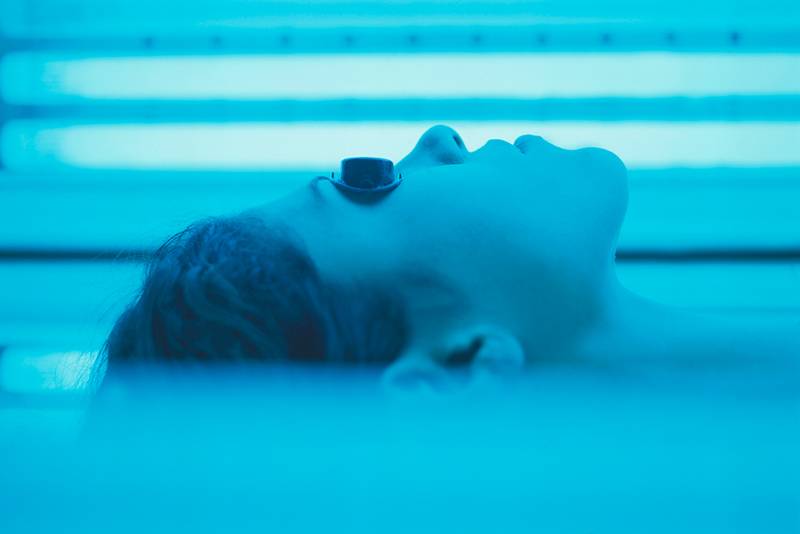
The Food and Drug Administration (FDA) has withdrawn its much-discussed proposal to restrict minors from accessing tanning beds. The rule, which would have banned those under 18, was officially pulled on Tuesday, March 17, sparking widespread conversation among dermatologists.
Featured Experts
- Janine Hopkins, MD is a board-certified dermatologist in Southlake, TX
- Kavita Mariwalla, MD is a board-certified dermatologist in West Islip, NY
The Ban
First introduced in 2015, the ban was designed to help curb the skin cancer risks tied to indoor tanning, particularly among younger users. The decision to withdraw it comes despite significant research linking tanning beds to an increased risk of melanoma.
Dermatologists say it could also send a confusing message about the risks and safety of UV exposure to young Americans and their parents. “Dermatologists have for a long time known the harmful risk of UVA/UVB radiation on the skin,” says West Islip, NY, dermatologist Kavita Mariwalla, MD. “We know that it is a direct cause of melanoma and skin cancers.”
Dermatologists and the FDA alike have long been aware of the concerns surrounding tanning beds, even before the 2015 proposed ban. “In 2010, the FDA Advisory Panel recommended banning tanning bed use for people under the age of 18,” explains Dr. Mariwalla. “The goal was to classify tanning beds and sun lamps as a device that was high risk and required stricter controls or prohibition for minors. The problem was that this was not really enforced.”
Then, in 2014, more changes followed. “The FDA reclassified tanning beds from a Class I to a Class II carcinogen but required a black box warning,” she says. “However, there was still no federal prohibition. Thus, it was left to the states to regulate who was using a tanning bed.” Finally, in 2015, the FDA proposed a formal rule. In addition to a nationwide ban on tanning bed use for those under 18, it would have also “required adults to sign risk acknowledgment forms every six months,” says Dr. Mariwalla. “In early 2024, the rule was in its final stage, but just recently the FDA formally withdrew the proposed rule.”
What Happens Now
As a result of this rollback, enforcement will be left to each state. “We are back to a patchwork of rules,” says Dr. Mariwalla. “Some states have banned the use of tanning beds for people under 18, others require parental permission and others have weaker restrictions.” She notes that this signals that the use of tanning beds is not a priority at the federal level, which she calls a “shame” as a dermatologist.
Even though this is not a priority for the FDA, the science behind tanning has not changed. “As dermatologists, we’ve spent decades educating patients that there is no safe tan,” says Southlake, TX dermatologist Janine Hopkins, MD. “The science is unequivocal: UV exposure from tanning beds causes DNA damage and significantly increases melanoma risk, especially when exposure begins at a young age.”
She notes that it’s not just a policy decision but also a public health setback. “Indoor tanning is a known carcinogen, and starting before age 18 can increase melanoma risk by nearly 50 percent,” Dr. Hopkins adds. “This is one of the few cancer risks in medicine that is entirely preventable. Allowing minors access to tanning beds sends the wrong message at the worst possible time—before lifelong habits are formed.”
The ruling also comes amid continued interest in tanning among younger demographics. “I see young people continuing to tan,” says Dr. Mariwalla. “They do it before prom, they do it to ‘not get a burn’ before going on vacation and they do it because their friends are doing it.” Dr. Hopkins also notes that, in the short term, “we may see increased use among teens, particularly in states without strict regulations.”
Potential Effects
Walking away from this proposed ban doesn’t just affect teens and children in the short term, but long term as well. “This raises serious concerns about increased rates of melanoma and other skin cancers, along with accelerated photoaging and cumulative UV damage,” says Dr. Hopkins. Dr. Mariwalla is already seeing skin cancer in younger patients, not just older ones. “I do see skin cancer in younger and younger patients,” she says. “It truly is reaching epidemic proportions. And this is not just for melanomas but also basal cell carcinoma.”
Here’s the bottom line for parents and minors to know about tanning beds: “Tanning beds are not a safe alternative to sun exposure—they emit concentrated ultraviolet radiation that directly damages DNA in skin cells,” says Dr. Hopkins. “Early exposure significantly compounds lifetime risk.” Instead, she recommends opting for sunless tanning products. Try self-tanning body products like St. Tropez Self Tan Express Bronzing Mousse ($46) or face products like Isle of Paradise Self-Tan Face Drops ($30).