May is Melanoma Awareness Month, and every year when it comes around, I feel a pull in my chest—equal parts grief and gratitude. It’s the month I use my voice the loudest, because I know firsthand how quiet this disease can be—until it isn’t.
I’m Leah Adams. I’m a melanoma survivor, a marathon runner, a former tanning bed user and an only child who watched her father fight stage 4 metastatic melanoma in his brain and lungs. I tell this story not because it’s easy, but because I believe sharing it might save someone else from living it.
My Dad Was the Warning I Almost Ignored
It started with my dad in August of 2019. My mom noticed a suspicious mole on his upper back and urged him to get it checked. He was 60, had fair skin, European descent and a history of sun damage that stretched back to my childhood—summers mowing the lawn without a shirt on, golf rounds with no sunscreen, sunburns that turned into tans he didn’t think twice about. His own father had dealt with basal cell and squamous cell skin cancer, so the risk was there. It just wasn’t something we talked about.
The dermatologist biopsied the mole. A week later, the results came back: stage 0 melanoma, also called “melanoma in situ.” The earliest possible stage. He underwent a wide local excision to clear margins and was told to return every six months for skin checks. I exhaled. I told myself, “He caught it early. It’s fine. That’s what happens to people his age.”
I was 25 at the time. And I truly believed melanoma was an older person’s disease.
The Mole on My Chest
One month after my dad’s diagnosis, my mom found a mole on my chest that didn’t look right. She looked at me the same way she had looked at my dad and said, “You just saw what your dad went through. Go get a skin check.”
I rolled my eyes, gently and thought: “I’m 25…almost 26. That can’t happen to me.” But I also knew my history. I grew up in Midwest Ohio, pale and determined to be tan every summer. I’d spent years baking in my backyard without sunscreen, chasing a color that didn’t come naturally to me. When I was 16, my mom actually had to sign a waiver for me to go into a tanning bed for the first time, and we went together.
By the time I was in college, I was going regularly, taking advantage of every special the tanning salon near campus offered. I kept going through grad school. My mom started noticing I was getting darker, that the moles on my body were multiplying like my dad’s. She would say, “Leah, watch how many times you go. Those aren’t good for you.” I heard her. I just didn’t really listen.
But after my dad’s diagnosis, her voice stuck with me. I Googled photos of melanoma. I tried to convince myself the mole on my chest was nothing. And then, to get that assurance officially, I made my first appointment with a dermatologist.
I was freshly 26. I had never had a skin check before. I remember feeling exposed—not just physically, but in every way. They asked about my sun history, my family history and whether I wore sunscreen. They looked at me from head to toe. And the only mole they flagged was the one my mom had noticed.
They biopsied it and told me I’d have results in three to five business days.
The Call That Changed Everything
Day five came and went. Then day seven. Then day ten. I called the office, slightly uneasy, and was told the mole had looked so atypical that they’d sent it for additional testing and staining. I didn’t know what that meant. I just knew it wasn’t the quick, easy answer I’d been hoping for.
On day 14, I got the call. I was with my boyfriend (now my husband) when my dermatologist asked if I had time to go over my biopsy results. The second I heard her tone, I knew.
“Unfortunately,” she said, “that mole came back as Stage 1A, bordering Stage 1B malignant melanoma.”
I remember the room going from color to black and white. My dad’s had been stage 0. Mine was higher. Already worse. Because of the depth of the melanoma and my family history, they needed to get me into surgery immediately. They also wanted to perform a sentinel lymph node biopsy to see if the cancer had spread.
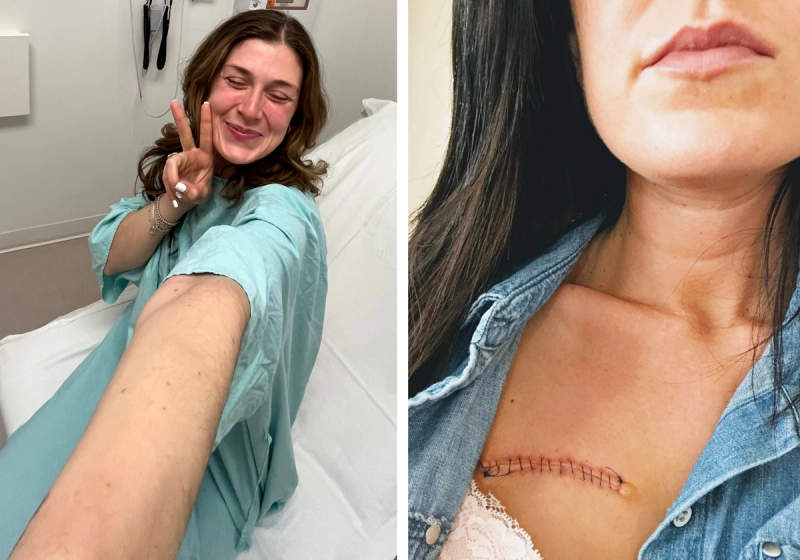
Two weeks later, I was in an outpatient surgical center under full anesthesia for eight hours. The only other surgery I’d ever had was getting my wisdom teeth out. This was nothing like that. When I woke up, and they showed me my incision sites—a significant wound on my chest where they’d taken a wide margin of skin and an incision under my arm where they’d removed lymph nodes—it hit me. This was real. This was my body. This was my life now.
Running Toward Recovery
Before the melanoma, running was my anchor. It still is. The first thing I asked after waking up from surgery was when I could run again. The answer was: not for a while. The lymph node removal put me at risk for lymphedema, and my incision sites needed time. I was told to rest when what I desperately wanted was to move.
That period after surgery was one of the darker stretches of my life. I was 26, recovering from surgery for the deadliest form of skin cancer, waiting to find out if it had spread to my lymph nodes, and suddenly reckoning with the fact that my life was going to look different—no tanning beds, serious sun protection, regular dermatology appointments for the rest of my life.
A few weeks later, I got the call I’d been dreading and praying over at the same time: the melanoma had not spread to my lymph nodes. It had not reached my organs. I was clear.
I cried. And then I started figuring out who I was on the other side of it.
When My Dad’s Cancer Came Back—Stage 4
I spent the next year or so in trial and error, finding sunscreens I loved, building a sun-protective wardrobe and slowly opening up on social media about what I’d been through. Then the pandemic hit, and with it came isolation. I didn’t know anyone my age who had been through melanoma. Sharing my story online felt like reaching out in the dark, hoping someone would take my hand.
And then, in January 2021, my dad had a seizure while driving with my mom.
He was in the ICU. I couldn’t even be with him because of pandemic restrictions, which allowed only one visitor per patient. When they did a brain scan, they found lesions. The pattern was unmistakable to the doctors: stage 4 metastatic melanoma. A full-body scan confirmed it. His lungs, they said, lit up like a Christmas tree.
His stage 0 melanoma from 2019 had, quietly and without symptoms, spread to his brain and his lungs. All of it was inoperable. The only options were Gamma Knife radiation for the brain and immunotherapy for the lungs.
I’m an only child. My mom became his primary caregiver. I became his secondary caregiver. Watching a parent navigate stage 4 cancer while still processing your own diagnosis with the same disease—just at a different stage—is a particular kind of heartbreak I don’t have the right words for. The radiation came with brutal side effects, including brain swelling. The immunotherapy, which works by activating the immune system to fight the cancer rather than attacking the cancer directly, landed him in the emergency room repeatedly in those early rounds.
Melanoma cost my dad his ability to drive for nearly two years after his seizure. It forced him into early retirement. It has affected him emotionally, financially and cognitively. All because of something that was, at its root, preventable.
Turning Pain Into Purpose
I could have let all of this harden me. I could have gone quiet and bitter and angry. I chose differently. I turned pain into purpose and took my story to social media.
Every week, I get messages—from high school friends, from strangers, from people who’ve been following along—asking for sunscreen recommendations, sharing that they finally made a skin check appointment, sometimes even sending me photos of moles they’re worried about (to which I always say: please go see a professional for that one). Those messages are why I keep going. They are proof that telling the truth about what happened to my family is doing something.
I’ve gotten involved with melanoma organizations. I’ve spoken about my story at events around the country. I’ve built a community online with people who truly understand—not just sympathize, but get it—because they’ve lived it, too. Some of them I’ve only met once, at a melanoma conference. Some I haven’t met in person yet. But that connection is real, and it matters more than I can say.
What I Want You to Know This May
Melanoma is the deadliest form of skin cancer. It is also one of the most preventable cancers. And it does not care how old you are, what your skin tone is or whether you’ve ever thought of yourself as someone who “burns easily.” I was 26. My dad was 60 when his was caught, and 62 when it came back with a vengeance.
A tan is not healthy. It is your skin’s DNA signaling that is damaged. Tanning beds are not safe. Sunburns are not just uncomfortable; they accumulate. And skin checks save lives. My mom’s eyes saved mine.
If you haven’t had a skin check recently (or ever), please make an appointment. If someone in your life has been putting it off, be the voice in their head like my mom was in mine. If you see something that doesn’t look right, say something.
This month, and every month, I’ll keep telling my story; I’ll keep talking about it as many times as I can. Because the more we share, the more lives we protect.