One in five Americans will develop skin cancer in their lifetime, a stark reminder to get SPF right daily—but even with SPF 30+, small missteps can still compromise our coverage.
Ahead, three dermatologists on our Brain Trust break down where routines fall short and how to fix them.
Overestimating SPF Numbers
Higher SPF isn't the protection boost it sounds like. "The reality is: SPF 15 offers about 93 percent protection, SPF 30 about 97 percent, SPF 40 about 97.5 percent and SPF 50 about 98 percent," says Montclair, NJ dermatologist Jeanine Downie, MD. "After that, sunblock levels off because there is no such thing as 100 percent protection from the sun's rays."
Thinking Melanin Is Built-in Protection
"People with melanin-rich skin often think they have automatic protection and, thus, are less diligent with their sunscreen application," says Santa Monica, CA dermatologist Ava Shamban, MD. "More melanin is not a get-out-of-sunscreen card. While it provides slightly more natural protection than fair skin, it's not enough to prevent UV damage."
Forgetting to Reapply
A single morning application doesn't last all day. "UV exposure accumulates and sunscreen breaks down with light, sweat and time," says Seattle dermatologist Heather D. Rogers, MD. "I've had patients apply SPF at 7 a.m. and still develop sun damage because they never reapply." UV levels are highest between 10 a.m. and 4 p.m., so Dr. Shamban urges her patients to reapply every two hours—as well as immediately after swimming or sweating.
Applying It Too Late
Sunscreen isn't meant to be applied as you're heading out the door. "It should be put on prior to leaving the house so it can be more effective," Dr. Downie says. It needs about 20 minutes to dry down and form an even, protective film before skin is exposed to UV rays.
Stopping at Your Jawline
Aside from the rare turtleneck day, dermatologists suggest treating your face, neck and décolleté as one. "Patients don't always realize just how much sun exposure their neck and chest receive," Dr. Shamban says.
Saving SPF for Sunny Days
"Sunscreen is a lifelong commitment—365 days a year," Dr. Shamban stresses. "It is not exclusively a summer skin-care product," and the need for it "is not based on the temperature or weather." That extends beyond time outdoors: "Up to 75 percent of UVA rays can pass through window glass, while blue light from phones and computers can also accelerate skin aging," Dr. Downie adds. Reality check: Cloud cover doesn't block UV—up to 80% of rays can still get through.
Relying on Makeup for SPF
Makeup with SPF can help, but it's not enough on its own. "No one applies enough foundation to get the proper labeled SPF," says Dr. Rogers. Consider it a bonus—not your primary protection. "You would need to apply a much thicker layer than is typically worn—potentially four times the amount to equal an FDA-approved sunscreen product," adds Dr. Shamban.
Not Using Enough
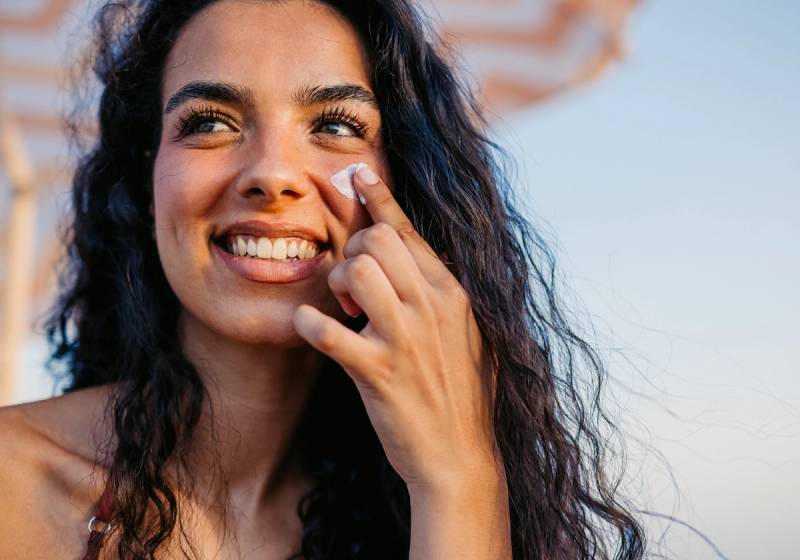
Most people apply only 25 percent to 50 percent of the recommended amount of SPF. "For the face alone, that means about one-fourth of a teaspoon, or roughly a nickel-size amount, every morning," adds Dr. Rogers. And don't forget your lips! The American Academy of Dermatology recommends protecting them daily with SPF 30 or higher.
Treating SPF as Protection Only
Friendly reminder: Your SPF can pull double duty. "Use a multipurpose formula with ingredients that support hydration, rejuvenation, cellular communication and barrier function," says Dr. Shamban. Look for ingredients such as peptides, vitamins C and E, hyaluronic acid, sterols and niacinamide.
Not Using a Formula You'll Stick With
"There are so many SPF formats now—including powders, gels, face mists, solid compacts, serums, body sprays, hybrid lotions and tinted formulations—so there is no longer an excuse for why someone can't use sunscreen, and also reapply it," says Dr. Shamban. "The best sunscreen formula is really one that you will continue to wear daily and be committed to."