There are two things everyone knows about Listerine: It works, but it burns. That 30-second swish has always been a small act of endurance—eyes watering, counting down, bargaining with yourself to make it to the end. The burn was practically the brand’s handshake. If it didn’t sting, was it even working?
So, when a whitening Listerine landed on our desks, we braced ourselves. Whitening on top of that famous burn sounded like a concoction that would only double the sting.
We are pleased to report that the experience was the exact opposite.
“When we looked at the options in the marketplace, we saw a massive disconnect: 85 percent of consumers were interested in using a whitening mouthwash, but the fear of enamel damage and tooth sensitivity was holding them back,” says Steve Ries, head of oral care at Listerine, citing a Kenvue-sponsored consumer focus group. “As the number-one dentist-recommended mouthwash brand, we knew we could help.”
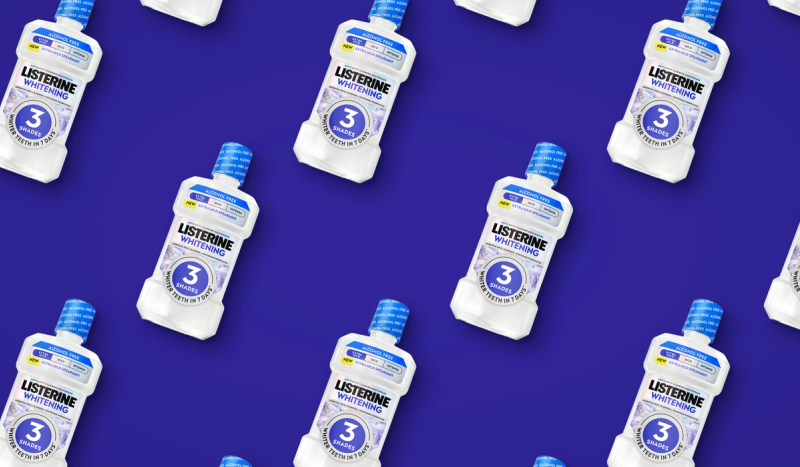
The brand’s answer is the new Listerine Whitening Mouthwash ($8). It’s a whitening rinse with no peroxide and no alcohol. “Our goal was to create a formula without peroxide, using gentle ingredients,” Ries explains. “The goal was to offer a solution that not only effectively removes stains, but also strengthens enamel and forms a protective shield to prevent future stains from forming.”
So how does a mouthwash whiten teeth without peroxide? Polyphosphates do the work. “Simply put, our mouthwash is designed to help remove surface-level stains and get you back to the natural white smile you were born with, all while preventing future stains and delivering the clean that you can only expect from Listerine,” Ries says. “We use polyphosphates to gently whiten teeth, displacing existing stain molecules and binding to the tooth enamel to create a protective shield, leaving teeth three shades whiter in just seven days, based on our in-vitro study.”
A quick note on that last part: “In vitro” means the three-shade result came from a lab study, not a study of people using the rinse. The rinse is designed to remove surface stains, rather than bleach the underlying tooth color. If you’re hoping to lift stains from coffee, tea or red wine without adding a whitening step to your routine, it may be worth a try.
“We expect users to notice a much gentler experience than what they’ve come to expect of whitening products in the past,” Ries continues. “It is truly a peroxide-and-alcohol-free formula that delivers stain removing benefits without a harsh trade-off.”
What we like most is how little it asks of you. There are no trays or strips sliding around while you wait. It fits into a regular oral-care routine. “We also recognize that oral care is becoming increasingly relevant in the beauty space,” Ries says. “So we wanted to deliver an easy-to-use whitening solution that can seamlessly fit into daily self-care and beauty routines.” After trying it, we can see the appeal.