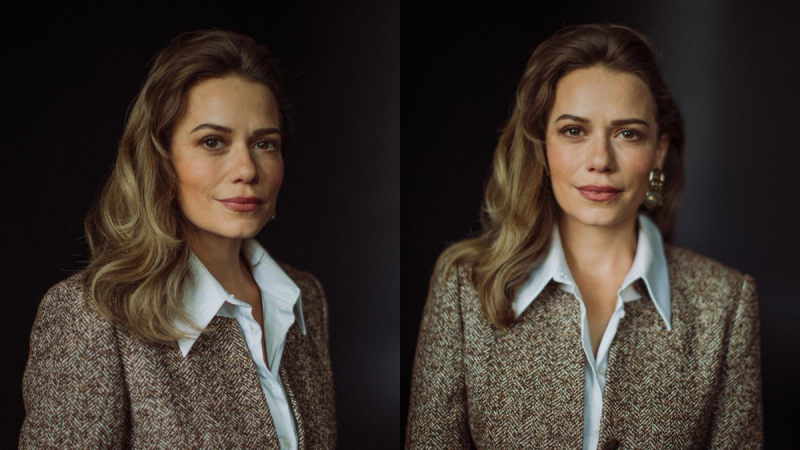
Bethany Joy Lenz doesn’t do anything halfway—including her own book cover. For The Betrayal of Cora Wexford, her new novel out today from Simon & Schuster, the actress, director, singer and author hand-painted the portrait that greets readers before they turn a single page. It’s a fitting detail for a story about a painter: Cora Wexford, a 38-year-old American who has fled to 1880s London and makes her living painting the dead.
When a suffragist and a gallery owner commission Cora to paint ordinary women whose deaths were caused or enabled by a system that ignored them, her work collides with the Jack the Ripper murders—and with a charming new love, Miles Vale, who grows more disorienting by the day. Publishers Weekly says “fans of historical fiction will thrill to this dark tale.”
For readers of Lenz’s bestselling memoir, Dinner for Vampires: Life on a Cult TV Show (While Also in an Actual Cult), the themes will feel familiar: manipulation that looks like love, women made invisible and the communities that look away. Here, Lenz talks about writing from experience, the Victorian beauty rules that were sold as “protection,” the Haley James Scott look she’d still wear today and what Cora would buy at Sephora.
You hand-painted the cover of The Betrayal of Cora Wexford, and Cora is a painter herself. How did your own art shape the book, and what was it like to create the image readers will see first?
“My own art shaped the book in several ways. I think the first is that, because I love painting and have done it for many years as a quiet hobby, I have a basic understanding of light and color and what it feels like to get involved with the paint and to build something from scratch in a way that is very tangible.
And the other is that I just have an endless curiosity about it. I would love to become a better painter. I haven’t had a ton of time, I think, to focus on learning that, but maybe that’ll be in the next season of my life.
But because of my curiosity, it made the research element of that part of the book really fun and engaging for me. So when I started painting the portrait, I really wasn’t sure how it was going to go. I did it more as an experiment. And because I was writing, while I was simultaneously painting, a lot of the things about the artwork itself made its way into the book, into Cora’s character. So it was a very meta experience bringing the painting into the story in that way, and having Cora interact with something that I was physically creating.
I don’t pretend to be a terribly skilled artist, but I do feel that what I ended up painting does accurately convey the emotion that I wanted readers to feel when they first saw the book. So whether it’s perfect or not, I do feel like it does what art is supposed to do, which is make you feel something. I’m grateful that Simon & Schuster felt the same way and wanted to put it on the cover.”
Cora makes her living painting portraits of the dead, and then she’s commissioned to paint women the system ignored. What drew you to the idea of making invisible women visible through art?
“I think art is the only way I know how to express myself, and because I know what it feels like to have been made invisible. I have so many friends in my life who have been made to feel invisible and I’ve seen the incredible damage that that kind of isolation and ostracization has caused. And I hope that the stories I tell are effective in communicating a message to the audience that makes them think differently about their own lives and their own perspectives.”
The book asks whether it’s worse to die at the hands of a stranger or to be ‘dismantled over years’ by someone you love. Dinner for Vampires explored how manipulation can feel like love. How did your own experience shape the way you wrote Cora and Miles?
“One of the difficult things for people who have never experienced manipulation and coercion in an incredibly detrimental way, is that you can’t really understand what it feels like to be inside the imaginary world of the narcissist or the manipulator. It’s like The Truman Show, and you’re inside of it, and you believe what you’re being told because you want to be a trusting person, and you want to believe the best in people. And these manipulators are so skilled at preying on exactly that. That is what they look for, someone who is highly emotionally intelligent. Someone who is not easily swayed. There’s no high or dopamine hit for these manipulators, to win over someone who’s gullible. They want someone to conquer who is sort of unconquerable and unbreakable. And so the way that I wrote Cora and Miles was a direct result of my deep and complex understanding of the inner workings of that personality disorder and how relationships with those people go.”
The 1880s had strict and often dangerous beauty standards, like arsenic complexion wafers, lead-based powders and corsets. Did you research what women went through to look “acceptable” back then, and did any of it make its way into Cora’s story?
“There were so many bizarre beauty concerns back then in Victorian times. Some of which haven’t changed—the methods have changed, but dangerous beauty standards have not. I think because Cora really bucked the system in so many ways, she was not interested in looking like everyone else or conforming to the beauty standards. She hated wearing a corset, which was pretty scandalous for the time. So anyway, that’s all to say that because she was not terribly interested in a lot of these beauty standards, I didn’t spend a ton of time figuring out what those were going to be back then because she just wasn’t going to live in them. With the exception of a few small things, like gloves and hair being up. She blended in with the crowd intentionally.
Her friend Madeline was much more interested in beauty and being of the moment. She had all the right fabrics, all the right colors, all of the right home decor that was constantly turning over. Madeline is the fashionista of the book. But it’s not Madeline’s story. That being said, I did find it really interesting, all of the ways that the expectations on women constrained them: making sure their hair was a certain way, making sure their corsets were on and done up, making sure their ankles weren’t showing, making sure their hands were gloved.
The tale being told throughout society was that these standards were supposed to be some sort of protection for women. And of course, the question then becomes protected from whom? From men. So I thought that those particular pieces were just one indication of what was really going on in society as a whole, which I think is still happening.”
Your podcast, Drama Queens, has centered healing through female friendship, and the book explores community complicity. What do you hope women take away about protecting and believing one another?
“I think what we realized doing Drama Queens was how powerful it is when you speak the truth of what has happened to you and you share it and you don’t allow shame to hide you away. And because most of the manipulation, abuse and coercion on this planet is carried out by men, it is sort of a byproduct that it’s women who are in need of each other and each other’s stories, and each other’s voices.
However, narcissism can come in many shapes and sizes, and it may come from people you least expect, women included. Yes, women need women right now and female friendship is very important. But the takeaway is that you need to educate yourself if you want to know how to be a good friend and a really, truly helpful member of society.”
You write, act, direct, sing, paint and host a podcast. What does taking care of yourself look like during a launch week, and do you have any beauty or wellness rituals you rely on?
“Taking care of myself during launch week looks like a lot of vitamins and a lot of water. I’m getting as much sleep as I can. And that’s really all I can do, along with just praying. I’ve been praying the rosary lately and that’s been really beautiful. There are just some really lovely Catholic and Orthodox prayers that I have been implementing into my day-to-day life. And taking that time has become really important to my self-care.”
You played Haley James Scott for nine years, which spans a lot of 2000s beauty trends. Which of Haley’s looks do you love, and which make you cringe?
“I did always love a pair of low-rise jeans with a crop top. It’s just so cute. Like what Haley was wearing in one scene in the pilot, when she and Lucas are walking down the street, with that little baby-blue tee and her jeans and her little like crossbody strap bag. I just think it’s so cute and fun. In terms of my least favorite looks, any time I was in a long, tight shirt over jeans to my hips, it felt like such an unflattering shape. I don’t know how that one ever became trendy.”
What did your beauty routine look like in your early 20s, compared with today? What’s the biggest thing you’ve changed or let go of?
“Honestly, I don’t think much has changed. I think I’ve never liked wearing a lot of makeup, so I don’t know that much has changed. I use more balm on my skin now than I did before. I use Froya and Jones Road. And I think I also spend a little bit more time on my hair care probably than I did back then. Like now I will be sure to rinse out my conditioner with really cold water. And just brush my hair more often.”
If Cora Wexford walked into a modern beauty store, what’s the first thing you think she’d buy?
“Well, the Cora we meet in the beginning, I think, is different from who she is in the end. So if it’s the full circle at the end of the book, and Cora suddenly walked into a Sephora, she probably would buy brushes. I think that would be the first thing. And then she’d get lost in all the palettes, I’m sure. I would love to see Cora in a Sephora.”
This interview has been edited and condensed for clarity.