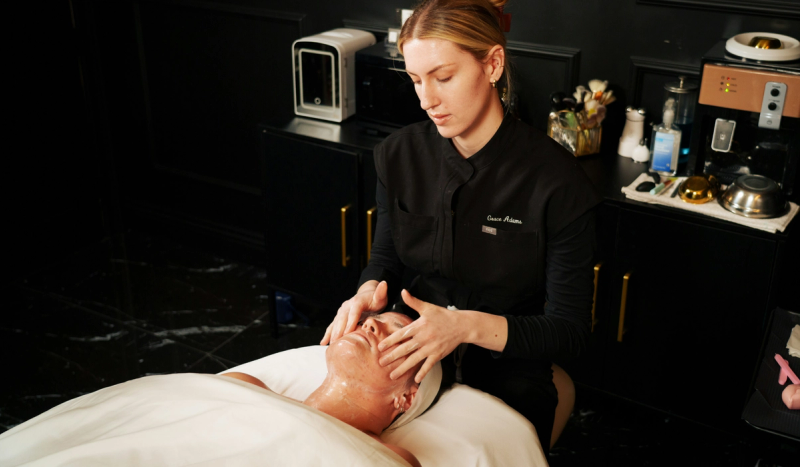
There’s a moment in nearly every facial when the warm towels and dreamy massage give way to something a little less zen: extractions. For some of us, it’s the entire reason we booked the appointment (hello, stubborn nose blackheads). For others, it’s the part we’d happily skip. So who actually needs them, what should they feel like, and how do you know your aesthetician is doing them right? We asked two pros who spend their days clearing pores to break it all down.
Featured Experts
- Lexie Bennett is a licensed aesthetician based in San Diego and the community lead at milk + honey spa, medspa and salon
- Samantha Susca is a licensed aesthetician based in New York and founder of Refinery4
What Are Facial Extractions, Exactly?
In simple terms, extractions involve removing the buildup of oil, dead skin cells and other debris trapped inside pores. They’re commonly performed during facials to address blackheads, whiteheads and certain types of superficial breakouts, but the process requires more than just squeezing a clogged pore.
“Extractions are particularly effective for blackheads, whiteheads and certain superficial pustules,” says licensed aesthetician Lexie Bennett, community lead at milk + honey spa, medspa and salon. “Deep cystic or nodular acne generally isn’t appropriate for traditional facial extractions and is better addressed by a dermatologist.”
New York–based licensed aesthetician Samantha Susca, founder of Refinery4, agrees: “Blackheads and non-inflamed whiteheads are usually the most suitable forms of congestion for extractions. These can be done manually for best results, occasionally using a lancet. Deeper bumps, known as closed comedones, are entirely different in nature, and only with extreme precision and experience, should be extracted with a disposable lancet only. The most important discernment is between congestion that can be safely released and a lesion that should be left undisturbed and pretreated with topicals before extractions can be considered.”
Who Should Get Extractions
If you have persistent blackheads, clogged pores or small, superficial blemishes, extractions may be a worthwhile addition to your facial. Both aestheticians say that some degree of congestion is common, but that doesn’t mean every pore needs to be cleared at every appointment.
“I can always find something worth extracting on every face I work with, so I would say extractions are for everyone, but the clients who tend to see the greatest improvements are those dealing with blackheads, clogged pores, closed comedones and small pustules,” says Bennett.
Susca is a big believer, too. “Extractions are the heart of most facials,” she says. “As an extraction specialist, I firmly believe that without clearing the pores, products cannot effectively do their job, and the skin cannot maintain and balance itself.”
And the payoff goes beyond a smoother T-zone. “Most skin types have a degree of congestion that even a gentle clearing can improve,” Susca adds. “This will lead to a decrease in bacteria and balanced sebaceous activity, resulting in a calmer and clearer complexion with a stronger microbiome long-term.”
But, that doesn’t mean every facial should automatically include extractions. “I look at congestion as an individual concern, rather than something that automatically needs to be addressed during every facial,” says Susca.
And Who Should Skip Them
Both experts agree that the state of your skin on the day of your appointment matters more than your skin type. “It’s less about a particular skin type and more about the condition of the skin,” says Bennett. “Not every blemish is ready to be extracted, though. Knowing when to leave something alone is just as important as knowing how to remove it. I tend to be more conservative with inflamed, compromised, irritated or broken skin, and deep, painful cystic breakouts. In those cases, calming inflammation and supporting the skin barrier should take priority.”
Susca takes a similar approach. “When I’m working with someone who is experiencing heightened sensitivity, active inflammation or a compromised barrier, I’m far more selective. I believe the most effective treatments begin with understanding what the skin can comfortably tolerate, not simply what we can remove from it.”
What Actually Happens During Extractions?
“Proper extractions begin well before any pressure is applied,” says Bennett. “First, we prepare and soften the skin, often using steam, a specialized solution or a combination of both. This helps loosen the buildup of oil, dead skin and other debris so congestion can be removed more easily. From there, we use controlled pressure and specialized tools to gently release the material obstructing the follicle.”
Susca also uses diamond microdermabrasion before extractions to remove the surface layer of keratinized buildup. “From there, I work selectively, primarily using gloves and just my own fingertips, which allows me to feel and regulate the pressure I’m applying.”
Bennett says she loves using an ultrasonic skin spatula for loosening surface congestion and addressing blackheads, and she reaches for a Schamberg extractor for more stubborn comedones. “And sometimes, gloved fingers and controlled manual pressure are the best tools.”
The experts differ on their preferred tools, with Susca favoring manual extractions. “I also never ever use a loop extractor tool, as I find those to be extremely damaging to the skin, ineffective for deep pore clearing, and difficult to keep sterile. They’re not necessary when proper manual technique is used.”
Once the extractions are done, the facial shifts gears. “I cleanse and treat the area with products appropriate for the client’s skin, focusing on calming inflammation and supporting recovery,” says Bennett. “Then we can transition into the more restorative, relaxing portion of the facial.”
What Separates a Good Extraction From a Bad One
It all comes down to restraint. “A good extraction is precise and causes as little trauma as possible. The goal is to clear the congestion without compromising the integrity of the skin,” says Bennett. “A bad extraction can leave behind torn skin, significant redness, bruising or more inflammation than was there to begin with. Knowing when to stop is part of being good at extractions. If something isn’t releasing with the appropriate amount of skin prep and pressure, it may simply not be ready.”
There’s also a certain discipline in knowing when to leave something alone. “I consider that one of the most important qualities of an experienced aesthetician,” says Susca. “A successful extraction should require very little manipulation. When the skin has been properly prepared and the congestion is ready to release, the process should be relatively effortless, making it easier to clear large areas of skin at once. The moment excessive force becomes necessary, the treatment is no longer serving the skin. Repeated squeezing in the same area to release a stubborn pore can cause damage, prolong inflammation and potentially leave behind marks that are far more difficult to address than the original congestion.”
Temporary redness and sensitivity can be normal side effects after extractions. “A few new whiteheads that reach the surface is common and expected after extractions as well,” says Susca. “Oil is the food source for bacteria in the skin, and when that oil is properly and evenly extracted, that bacteria will die off. As the subcutaneous bacteria dies off, redness can linger and some whiteheads may appear. This can last anywhere between a few hours to a few days, keeping in mind that sensitive skin may take a little longer.”
How to Tell If Your Provider Is Doing It Safely
Scarring, broken capillaries and post-inflammatory hyperpigmentation are potential risks of extractions, so here’s what to look for to make sure your provider is acting responsibly. “My first rule is always gloves,” says Bennett. “Proper sanitation and skin preparation are nonnegotiable. I also encourage clients to ask questions. Don’t be afraid to ask your aesthetician how they’re preparing your skin for extractions or why they’re choosing to extract a particular blemish. A knowledgeable professional should be able to walk you through their process.”
The big red flag? Pain and pressure that feel like too much. “Some pressure is expected, but sharp pain, aggressive squeezing or prolonged manipulation in one area as should never be necessary,” says Susca. Bennett agrees: “Extractions shouldn’t feel aggressive, and repeated forceful pressure is a red flag. Some temporary redness is expected, but significant bruising, broken skin or prolonged inflammation should not be the norm.”
And don’t skip the pre-facial chat. “I also think that thoughtful consultation is essential,” says Susca. “Skin that is reactive or prone to hyperpigmentation requires extra consideration, and recent use of exfoliating acids, retinoids or other sensitizing treatments should always be discussed. The skin can respond in different ways, and having a clear expectation and access to your provider in the subsequent days is just as important as the treatment itself.”
How Often Should You Get Extractions?
It depends on your skin. “There's no universal schedule for professional extractions,” says Susca. “Someone with persistent congestion may benefit from extractions every four to six weeks. Another person may need them only seasonally.” Bennett generally recommends starting with a professional facial about once a month for someone dealing with persistent congestion. “With consistent home care and regular professional treatments, many clients can eventually stretch their appointments to every other month or even seasonally.”
After your appointment, keep items that touch your face, including pillowcases, makeup brushes and eyeglasses, clean. Follow your provider’s aftercare instructions, too.
Why You Shouldn’t Do Extractions at Home
Both experts advise resisting the urge to pop your own pimples. “At-home extractions are a huge no for me, and that includes my own skin!” says Bennett. “We’re naturally more critical of our own faces, especially when we're standing inches from a mirror, so it’s easy to become fixated on a tiny blemish and end up doing far more damage than the original breakout ever would have caused. Without proper skin preparation, sanitation, lighting and technique, squeezing a blemish can increase the risk of infection, scarring and post-inflammatory hyperpigmentation.”
Susca agrees, noting that it’s easy to misread what you’re seeing on your skin at home. “What looks like a clogged pore could be something else,” she says. “Pressing on it without knowing what it really is or how to use proper technique for removal can impact a breakout deeper, cause inflammation in the surrounding pores, break small blood vessels or leave pigmentation behind.”