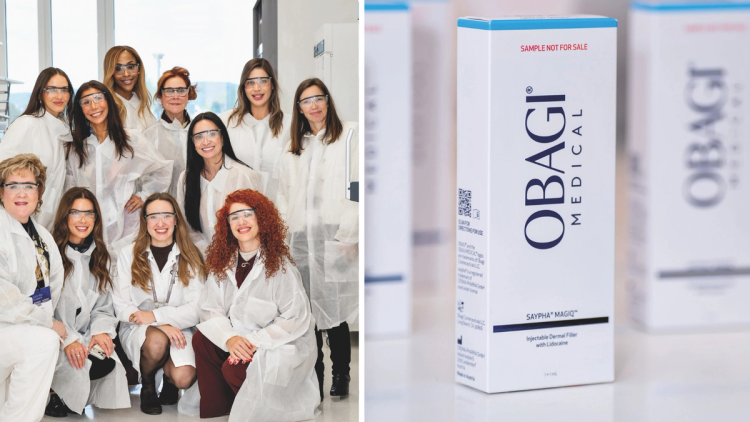

Choosing a cheek filler is about more than adding volume. The gel needs to provide the right support in the right place, with a result that still looks like you when you smile. Obagi ChIQ, which received FDA approval earlier this summer, is designed for that structural work. It joins the brand’s softer MagIQ filler, giving the two products different roles in treating facial volume loss and folds.
Here’s what ChIQ is made for, how the two formulas compare and what to know about results and recovery.
Featured Experts
- Sheila Barbarino, MD is a board-certified oculoplastic surgeon in Austin, TX
- Joel Schlessinger, MD is a board-certified dermatologist and cosmetic surgeon in Omaha, NE
- Daniel Schlessinger, MD is a board-certified dermatologist and Mohs surgeon in Omaha, NE
- Mary Lupo, MD is a board-certified dermatologist in New Orleans
What Is Obagi saypha ChIQ?
Obagi saypha ChIQ is a hyaluronic acid filler approved for cheek augmentation and correction of midface volume deficits in adults older than 21. The formula also contains lidocaine to help reduce injection discomfort.
ChIQ is part of Croma-Pharma’s established saypha filler line, which Obagi is bringing to the U.S. market. It joins Obagi saypha MagIQ, the first saypha filler launched in the U.S. under the Obagi name. The distinction between the two formulas starts with firmness. “It is a firmer, but not stiff, filler for more structural correction,” explains New Orleans dermatologist Mary Lupo, MD.
What Is ChIQ Good For?
ChIQ is designed to restore cheek volume and improve midface contour. The goal is fullness and definition that suit the face, including how the cheeks look at rest and when smiling.
“No one wants an overly projected or artificial-looking cheek,” says Austin oculoplastic surgeon Sheila Barbarino, MD. “The goal is to restore the soft, youthful fullness of the cheek—especially that natural apple of the cheek.”
ChIQ’s higher G-prime, a measure of gel firmness, helps explain its role as a structural filler. In general, a higher G-prime gel provides more support and is better suited to areas where the goal is shape, contour and lift. This is one reason a provider may choose a firmer gel when enhancing facial definition with filler.
How Long Does ChIQ Last?
Clinical results support improvement through 48 weeks, or roughly 11 months, in most patients. At that visit, 72 percent of ChIQ-treated patients still had at least a one-point improvement on the study’s midface volume scale, according to the FDA patient guide.
How long results remain visible can vary based on the amount used, the treatment area and individual factors. Obagi notes that the material may remain in the treated area for about two years, but that does not necessarily mean the same degree of visible correction will last that long. Cheek enhancement is generally tailored to a patient’s anatomy, baseline volume and desired degree of contour.
ChIQ vs. MagIQ
ChIQ provides firmer support for cheek volume and contour. MagIQ is softer and approved for moderate to severe facial wrinkles and folds, such as nasolabial folds, the lines running from the sides of the nose toward the mouth.
“I have been particularly impressed by Obagi saypha MagIQ for the nasolabial folds,” says Omaha, NE dermatologist Daniel Schlessinger, MD. “That is a particularly tricky area to treat while still looking natural, and truthfully, until MagIQ came along, I was never satisfied with any filler for treating these lines.”
“But we have absolutely loved the results from MagIQ,” he adds. “It injects very smoothly and predictably, and it gives consistent results. It has quickly become one of my favorite offerings.”
How Is ChIQ Different?
ChIQ is part of the same hyaluronic acid filler category as products in the Juvéderm, Restylane and RHA collections. Its formulation uses Croma-Pharma’s MACRO Core Technology, which creates a uniform gel intended to provide structural support. Hyaluronic acid fillers come in a range of textures and firmness levels, which is why the best choice depends on both the area being treated and the desired result.
For patients, the practical question is whether ChIQ’s firmer profile suits the correction they want. “It is a firmer, but not stiff, filler for more structural correction,” Dr. Lupo says.
Early feedback on the treatment experience has also been positive. “Obagi saypha ChIQ is one of my favorite fillers now because it provides a smooth and reliable experience,” says Omaha, NE dermatologist Joel Schlessinger, MD, whose practice participated in the clinical trials. Obagi entered the injectable category with MagIQ before expanding the line with ChIQ.
The choice ultimately depends on the area being treated and the result a patient wants. “Different fillers are designed for different areas of the face,” says Dr. Barbarino. “Once the initial swelling settles, the goal is to look like yourself—just more rested.”