The pre-consultation research process has a new first step, and it’s reshaping what dermatologists and aesthetic providers hear across the table. As artificial intelligence tools become a regular part of that process, providers say patients are showing up to cosmetic-treatment appointments with more information than ever, but not always the right information.
According to NewBeauty’s State of Aesthetics Summer 2026 report, 30.3 percent of patients say they’ve already used AI to research treatments, putting it ahead of YouTube (20.4 percent) and closing in on online forums (38.6 percent), both platforms that have had a decade-long head start.
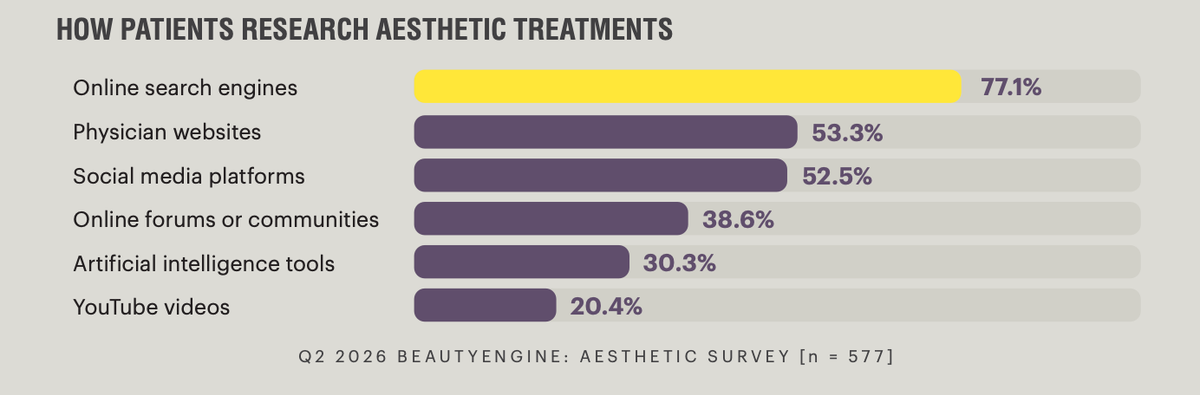
But more research doesn’t guarantee the right questions get asked. New York dermatologist Julie Russak, MD, sees it happen often: a patient comes in convinced they know what’s wrong, having asked an AI and gotten confirmation back. They type “I have jowls,” and the AI answers the jowls question. But when that same patient sits down in her chair, what Russak often sees is something else entirely, a different issue the patient never thought to ask about. “The answer was correct for the question asked,” she says. “The question was wrong. That's the most common form of misinformation I encounter, and it isn’t really the tool’s failure.”
Ahead, we’re diving into what else the report found, including how comfortable patients really are with AI, where it tends to mislead them and how to make it work in your favor before your next appointment.
Featured Experts
- Joel Schlessinger, MD is a board-certified dermatologist in Omaha, NE
- Daniel Schlessinger, MD is a board-certified dermatologist in Omaha, NE
- Jacob Beer, MD is a board-certified dermatologist in West Palm Beach, FL
- Julie Russak, MD is a board-certified dermatologist in New York, NY
People Are Warming Up to AI
Fifty-two percent of those surveyed describe themselves as comfortable turning to AI for treatment research, well above the 30.3 percent who’ve actually done it so far. That gap suggests a large pool of patients aren’t using AI yet, but they’re not resistant to it either.
West Palm Beach, FL dermatologist Jacob Beer, MD isn’t surprised. “Many providers find patients doing AI research to be off-putting but we don’t mind it in our practice,” he says. “I think that anything that helps patients feel empowered to discuss their concerns is a net positive.”
How People Are Using AI Right Now
Sixty-nine percent say they’d use AI for low-stakes tasks like learning more about treatments, while 67 percent would use it to compare procedures. Just 44 percent would use it to visualize potential results, which comes closest to replacing an actual consultation.
In practice, that line between researching and deciding isn’t always so clean. “Patients are coming with more information but also more misinformation from AI,” says Omaha, NE dermatologist Daniel Schlessinger, MD. He’s seen patients arrive with a specific “recipe” of injectables and lasers an AI told them they needed, or AI-generated, filtered photos of themselves they want him to recreate.
Where AI Falls Short
AI doesn’t know the patient. That’s the real limitation, says Omaha, NE dermatologist Joel Schlessinger, MD. “AI will give you many facts about a treatment, and some of them may even be true,” he says. “The problem is that AI doesn’t have any clue who you are and is, at best, as good as the knowledge you know to pass on to it.” He compares it to a game of telephone, where AI tools pull heavily from Reddit and other social platforms rather than peer-reviewed research, inflating the hype around treatments the evidence hasn’t caught up to yet.
More AI Blind Spots to Watch Out For
Treat AI as a starting point, not a verdict. That’s Dr. Daniel Schlessinger’s advice, and it comes with a warning about what the tool can’t weigh in on. “AI lacks taste and judgment,” he says. “It may give you a long list of treatments that may work for your condition or concern, but that doesn’t mean that you should do them or that you are a good candidate for them.”
Getting a better answer starts with asking a better question, according to Dr. Russak, and that means going wider than whatever brought you to the search bar in the first place. “If you type in a treatment name you’ll get a good answer about that treatment, and you’ll never find out it wasn’t the right one to ask about,” she says. Her fix is a simple change in phrasing: ask what to discuss with a doctor, not what to tell one. “That single change in phrasing gets you a set of questions instead of a set of instructions,” she says, “and it’s a much better thing to walk in with.”
Then there’s the concern that has nothing to do with accuracy at all. Dr. Beer points to privacy. “It’s important to remember that AI tools are generally not HIPAA compliant,” he says, citing OpenAI CEO Sam Altman’s own public comments that private medical or legal information shouldn’t be shared with AI tools expecting confidentiality.
The Takeaway for Practices
For providers, the shift isn’t about AI replacing any part of the process. It’s about how differently that process now begins. Patients are walking in curious, a little further along and ready to talk. They just need direction on where to go from there, and that part is still best left to the experts.