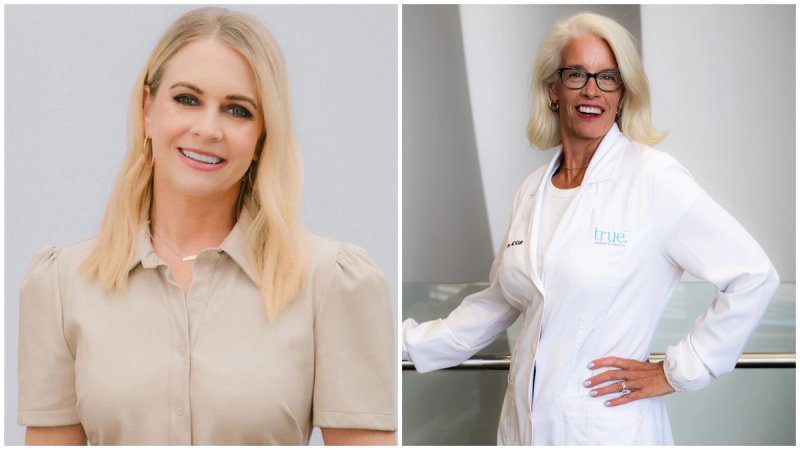
Melissa Joan Hart remembers her mom standing in front of the open fridge a handful of times growing up. She never explicitly said the word “menopause”—it just wasn’t discussed.
Now that she’s in it herself, Hart is doing things differently. She’s teamed up with Bayer and OBGYN and menopause specialist Diana Bitner, MD, on the “Life Doesn’t Stop for a Hot Flash” campaign to help women walk into their doctor’s office prepared.
“This is a conversation that hasn’t happened enough in the past,” Hart says. “There was a little taboo to talk about it before. I am hoping we’re the generation to unlock that. To be honest, I wasn’t really sure where to start…I didn’t know that there were treatment options available. I thought we just had to suffer through it.”
For Hart, it started with night sweats. “I was waking up in the middle of the night and kicking off all the covers,” she says. “I was the kind of person that went to sleep with socks on because I was always cold. All of a sudden, I’m drenched, and I can’t go back to bed.” What surprised her was learning that this counts as a moderate to severe hot flash. “If it takes you away from what you’re doing, then that’s a severe hot flash. For me, it was taking me out of sleep. It was happening once in a while, then it was more. I was like, ‘Wait a second, what is this?’”
She’s far from alone. An estimated 2 million U.S. women enter menopause each year, and many deal with hot flashes for seven to 10 years. “I think it’s crazy that 50 percent of women experience moderate to severe hot flashes in their first year of menopause,” Dr. Bitner says. “Women can be very distracted with these. In the middle of a board presentation or in the middle of a shoot for Melissa, they can be very interfering. Ten percent of women leave the workforce during menopause, and we just can’t have that.”
So where do you start? Dr. Bitner’s advice is refreshingly practical: Bring a list to your doctor. “How many hot flashes am I having? Some women can have them a few times a week. For some women, it’s several times a day, a night. I want them to come in with that information,” she says. “I think people are confused about why they happen, how long they’re going to last. There’s a lot of myths out there. In menopause, once you’re in it, it’s the rest of your life. We really want to set women up for success.”
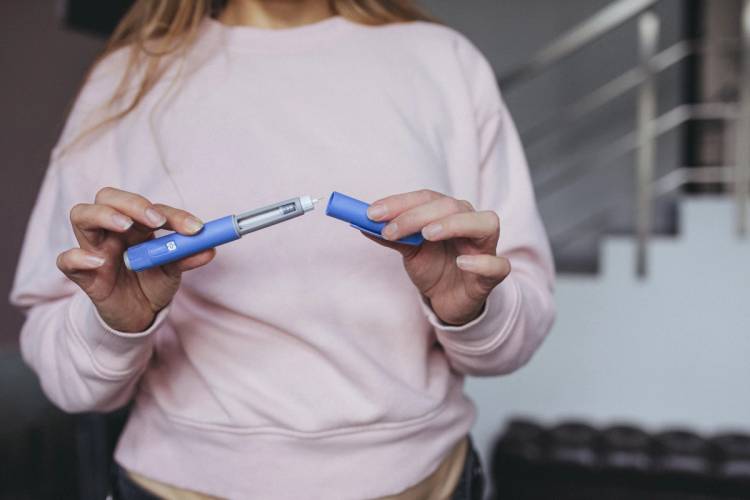
That includes knowing every option on the table. One of the newer ones is Lynkuet (elinzanetant) 60 mg capsules, an FDA-approved, hormone-free prescription treatment for moderate to severe hot flashes due to menopause. “I love that it works centrally in the brain, similar to hormone treatments, but it’s non-hormonal,” Dr. Bitner explains. “As an OB-GYN surgeon, I’m used to giving informed consent. Someone comes in with a problem, and we say, ‘Here are all your options, including do nothing.’ For some women, [hormone therapy] is just either not an option from a medical perspective or they just prefer not to.” Hart has been talking with her own doctor about treatment options; she isn’t on Lynkuet yet, but plans to get cleared at her next appointment.
Dr. Bitner is just as direct about the risks. “If people consider Lynkuet, we really hope that they get full informed consent. For example, I have a patient who drives a hi-lo at a nuclear power plant. Lynkuet can be associated with severe central nervous system effects and daytime impairment. I don’t want her to drive or operate her hi-lo until those effects have passed.”
On the beauty front, Hart hasn’t overhauled her routine as she’s gotten older, but she is the queen of consistency. “I can’t say my skin care has necessarily changed because I found something that worked for me in my 30s, and I’ve kept it that way. I might just slather on a little more now!”
She says her real beauty secret has been sleep. About 10 years ago, she started training herself to sleep on her back with a pillow under her knees (a natural side sleeper, she knew the pillow creases weren’t “helping any wrinkles”), and started using a weighted blanket. Then the hot flashes made that blanket “a little bit unbearable.” “I’ll go to sleep with my blanket on, but then I would have to rip it off in the middle of a hot flash. Then I’m tossing and turning all over the bed.”
Dr. Bitner says that lost sleep shows. “When women are sleeping well, it’s beauty sleep. If you have moderate to severe hot flashes and they’re waking you in the night, and then many women can’t get back to sleep, they don’t have that beauty sleep. We might not feel like drinking water, which we need to keep our skin with good turgor and all the things.”
As for what’s next, Hart is keeping details under wraps, but she says her Instagram is the place to watch. Right now, though, her focus is on keeping up the momentum: “I really just want to get out the word that we should be talking about menopause! Let’s keep bringing it up—talk to our sisters, our friends, our neighbors. Let’s keep the conversation going.”