Rhinophyma is a skin condition many people may have seen before, but don’t necessarily know the name for. The medical term describes the thickened, bulbous appearance that can develop on the nose in advanced rosacea—often paired with prominent pores (like an orange peel), some redness, visible blood vessels plus an uneven texture.
That said, it’s not exactly common. Not everybody is going to get advanced stages of rosacea and rhinophyma. It’s relatively rare compared to the overall number of cases of rosacea we see.
When it does develop, however, it typically evolves slowly over time. Although rhinophyma tends to become noticeable later in life, the underlying process often begins years earlier with untreated or persistent rosacea. Depending on how severe it is when patients seek treatment, options can range from medications and vascular lasers (to shrink the blood vessels) used to manage the condition’s early features, and later—to ablative laser resurfacing or surgical procedures that remove excess tissue and reshape the nose.
Here’s how the condition develops, who tends to get it and what treatment looks like today as a fellowship-trained laser surgeon and aesthetic dermatologist who treats rhinophyma regularly.
What Is Rhinophyma?
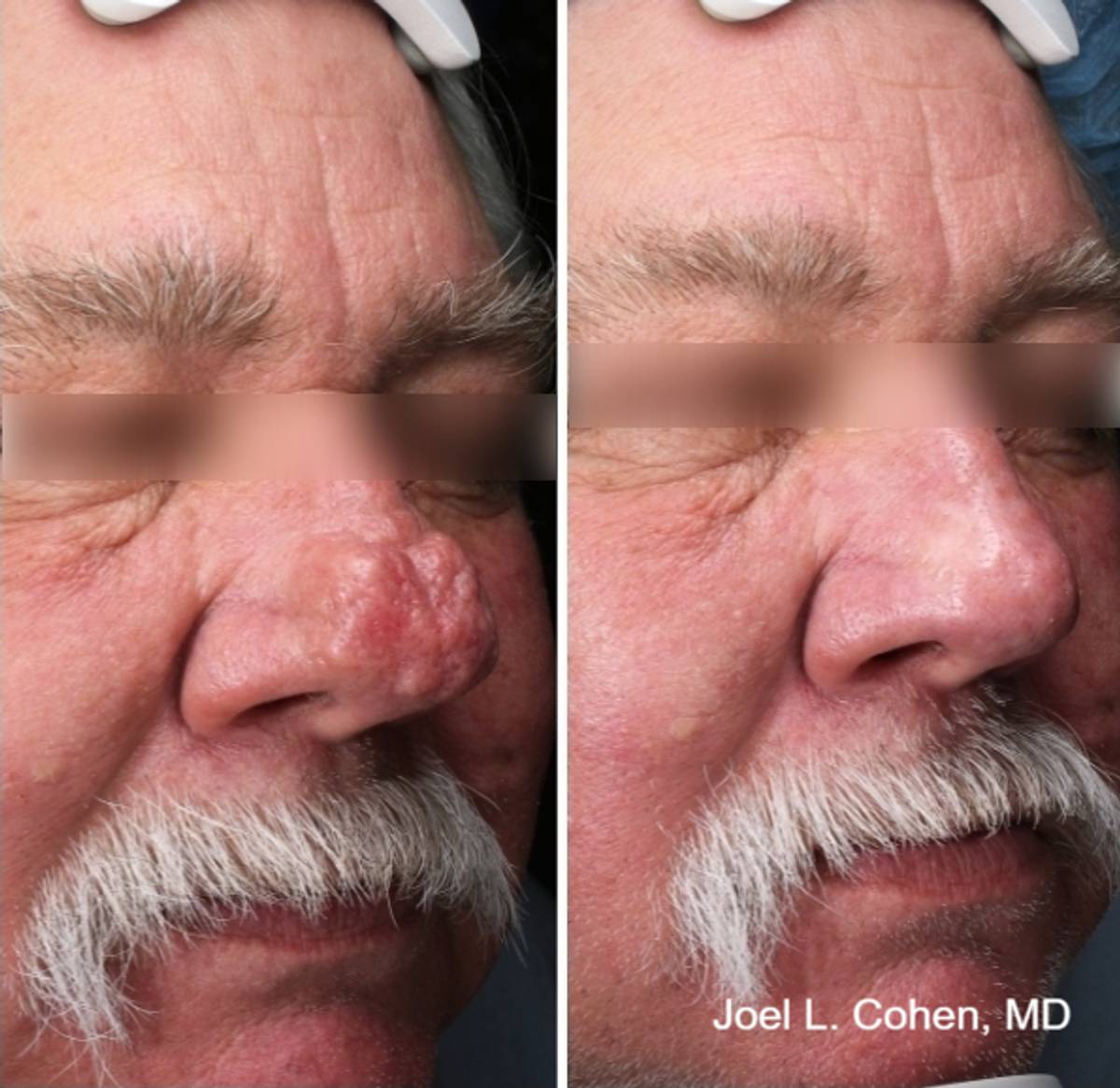
Rhinophyma is a thickening in the skin and the glandular tissue of the nose. It typically looks bumpy and bulbous, often red, with prominent blood vessels as well.
The condition is closely linked to rosacea, a chronic inflammatory skin disorder that commonly affects the nose and cheeks. The prominent cases I tend to see are really related to longstanding underlying rosacea that has gone untreated, particularly in terms of inflammation and growth of the glands and blood vessels.
As a result, the glands become enlarged like an orange peel—what we call hypertrophied. Over time, the oil glands beneath the skin (sebaceous glands) enlarge and grow unevenly, creating a very characteristic bumpy and bulbous appearance.
Although rhinophyma often becomes most prominent and severe later in life, I see patients in their 50s all the way through their 80s. However, early changes, such as thickening of the skin on the nose, usually start much earlier. If you go back and look at pictures, the signs are often there in the 30s or 40s, when the skin starts to thicken on the nose and a more glandular appearance begins to develop toward the tip.
The condition also appears far more frequently in men than in women. Some studies show it can be as high as a 30-to-1 ratio of men to women.
How Is Rhinophyma Treated?
Rhinophyma treatment depends largely on how advanced the condition has become. When rosacea is addressed early, treatment often focuses on controlling the condition before structural changes develop.
Early rosacea can often be managed with vascular lasers that target redness and visible blood vessels. I use devices such as the KTP laser (Excel V+) or pulsed-dye lasers (V-Beam) to target prominent blood vessels early in the condition. Managing rosacea early can help slow or even prevent progression. When patients start to develop inflammatory bumps or glandular changes, oral medications such as doxycycline at anti-inflammatory doses or isotretinoin may be used to help slow progression. At this stage, newer 1726 nm lasers, such as Accure and AviClear, may also be considered to help reduce sebaceous gland activity and inflammation.
At a certain point, however, we shift from managing rosacea symptoms to physically correcting nasal changes. Once patients develop that bulbous, bumpy, glandular appearance, we move toward procedural treatment. This involves different modalities to reshape the nose and remove excess glandular skin and thickened tissue.
The exact approach depends on the shape and severity of the tissue changes. For patients with very prominent, raised, glandular and asymmetric areas, I often use a scalpel in combination with an ablative laser to de-bulk and recontour. I then use the ablative laser (which vaporizes tissue) to not only remove residual thickened skin and glandular layers but also to blend the surface where the bumps have been reduced.
For resurfacing, I often prefer erbium lasers for their precision (such as Sciton Contour 2940 and Acclaro UltraClear 2910), although CO₂ lasers may also be used. Laser resurfacing is very precise, and erbium allows for recognition of the endpoint in terms of pinpoint bleeding. In other words, erbium identifies how deep in the skin that I am treating—by recognizing levels of bleeding. Erbium lasers are also more efficiently absorbed by water in skin cells and generate less heat than CO₂ lasers, which can help reduce collateral tissue damage.
What Does Recovery Look Like?
Recovery time depends largely on the extent of treatment. For milder rhinophyma cases, healing may take four to seven days. In more severe cases, healing can take 10 to 14 days for the skin to re-epithelialize (meaning the skin has “healed-over” and formed a new surface, although redness may linger as healing and inflammation continues).
During this time, patients need to be diligent with wound care. There may be some bleeding and weeping in the first few days. Patients should cleanse the area gently and keep it covered with ointment while it heals. Even after the skin has “healed-over” and closed, redness is expected as the tissue continues to remodel, and that redness can persist for a few months.
For many patients, the results are transformative, both physically and emotionally. Patients often return a couple of months later feeling more comfortable going out again, no longer worried about kids pointing fingers at their nose or people starting at them.
After bulbous rhinophyma changes are effectively treated with an ablative resurfacing laser, there is often a renewed sense of wanting to be social and out in the community again. That regained confidence can be just as meaningful as the physical improvement itself. I have had patients go from hiding at family social functions as the designated photographer, to actually posing in the center of every picture.