Type “psoriasis vs...” into the search bar, and it’s instantly met with its most common pairing: eczema. It’s a small but telling sign of how many people are trying to make sense of these two conditions, and how much confusion still surrounds them.
And the confusion is understandable: both conditions can cause red, inflamed, itchy skin, and both are far more common than most people realize. According to the National Psoriasis Foundation, psoriasis affects roughly 3 percent of U.S. adults, while the Asthma and Allergy Foundation of America reports that eczema affects about 7.3 percent.
Ahead, we’re diving into the differences between the two conditions, including how to recognize whether you have one, the other or both, what triggers and treats each and more.
Featured Experts
- Dendy Engelman, MD is a board-certified dermatologist in New York
- Kristina Collins, MD is a board-certified dermatologist in Austin, TX
- Shira Y. Wieder, MD is a board-certified dermatologist in New York
Psoriasis vs. Eczema
Both are chronic skin conditions that stem from different underlying causes, says New York dermatologist Dendy Engelman, MD. “Psoriasis is an immune-triggered condition that accelerates skin cell turnover, often creating thicker plaques with scale,” she explains. “Eczema, particularly atopic dermatitis, is closely tied to both immune dysregulation and a weakened skin barrier, which allows moisture to escape and irritants to enter more easily.”
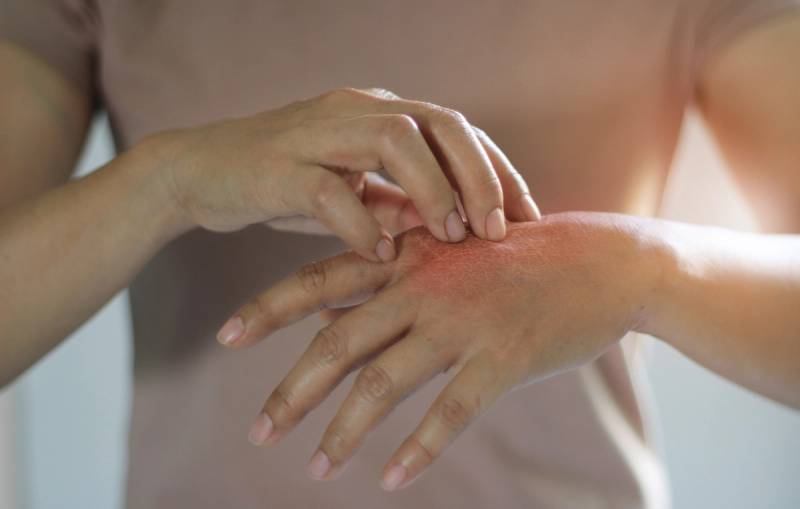
The two can look similar, but not to a trained eye. “Eczema tends to be intensely itchy and may appear dry, cracked, weepy or inflamed, whereas psoriasis classically produces more sharply demarcated, scaly plaques,” says Dr. Engelman. Location is another clue: psoriasis favors the scalp, elbows, knees and lower back, per Austin dermatologist Kristina Collins, MD, while eczema tends toward the face, neck, hands and elbow and knee creases—though either can appear anywhere.
Skin tone changes how both conditions present, too. “On lighter skin, psoriasis and eczema may appear pink or red, while on deeper skin tones, inflammation can look purple, violet, gray, dark brown or even subtle enough to be missed,” says Dr. Collins. Both conditions can also leave behind lingering pigmentation changes after a flare resolves.
As if telling the two apart wasn't hard enough, neither condition even comes in just one form. Plaque psoriasis is the most common form, showing up in up to 80 percent of cases, but guttate, inverse, pustular and erythrodermic psoriasis are also recognized subtypes—and it’s possible to have more than one at once, or develop a new type later.
Eczema covers even more ground: the National Eczema Association recognizes seven types, including atopic dermatitis, contact dermatitis (a reaction to something touching your skin) and dyshidrotic eczema (itchy blisters, usually on the hands or feet).
Is Psoriasis or Eczema Contagious? Are They Genetic?
Good news for the germaphobes among us: neither is contagious, confirms Dr. Collins. Genetics are a different story; both conditions can run in families, though not in quite the same way. Psoriasis tends to be more genetically driven, says New York dermatologist Shira Y. Wieder, while eczema comes down more to skin-barrier dysfunction.
Environment plays a role, too. For psoriasis, common culprits include strep infections, obesity, alcohol, smoking and certain medications, says Dr. Wieder. Eczema is less about exposure and more about how well the skin barrier holds up, with triggers such as fragrance, preservatives, dyes, irritants, microbes, weather changes and stress.
Are They Linked to Other Health Conditions?
Both conditions can extend well beyond the skin. About 20 to 30 percent of people with psoriasis go on to develop psoriatic arthritis, according to Dr. Wieder—a range that lines up with the National Psoriasis Foundation's own research on the condition. Left untreated, psoriatic arthritis can cause irreversible joint damage. Psoriasis has also been associated with a higher risk of high blood pressure, high cholesterol, obesity and type 2 diabetes.
Eczema, meanwhile, is tied to what dermatologists call the "atopic march:" patients who develop it, often in childhood, may go on to develop asthma and seasonal or food allergies. Dr. Collins recommends flagging any symptoms beyond the skin to a doctor so the condition can be managed as part of a bigger picture rather than in isolation.
Does Diet Play a Role in Flare-Ups?
Modestly, and differently for each condition. For psoriasis, Dr. Wieder points to research on Mediterranean-style anti-inflammatory eating and weight loss as supports to standard treatment; a gluten-free diet only tends to help if you also have celiac disease. For eczema, current guidelines actually advise against elimination diets, as the benefits are typically small and restriction can worsen allergies or lead to malnutrition.
Dr. Collins takes a similar stance: there's no single "psoriasis diet" or "eczema diet" that works universally, and she cautions against cutting out entire food groups without a clear, personal reason to do so.
Can You Have Both Psoriasis and Eczema at Once—and How Are They Treated?
Yes, it’s possible to have both psoriasis and eczema at once, or one after the other at different life stages. That’s why it’s worth getting a diagnosis confirmed before assuming a new flare years later is just the same old condition coming back.
As for treatment, it “depends on the diagnosis, location and severity, but both conditions benefit from consistent skin-barrier support and targeted control of inflammation,” explains Dr. Engelman. “Moisturizers and gentle fragrance-free skin care are particularly important for eczema, while prescription topical medications, phototherapy and systemic or biologic therapies may be used for either condition depending on severity.”
When Should You See a Dermatologist?
“I recommend seeing a dermatologist when a rash is persistent, recurrent, spreading, interfering with sleep or daily life, or not improving with basic skin care and over-the-counter measures,” Dr. Engelman advises. “You should also seek medical attention if the skin becomes painful, warm, increasingly swollen, crusted or otherwise concerning for infection.” Or, maybe you just want a clear-as-day answer that doesn't involve a search engine or a group chat diagnosis.