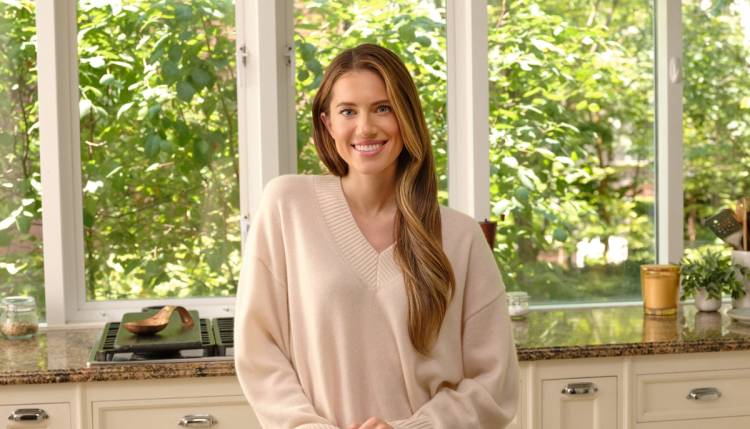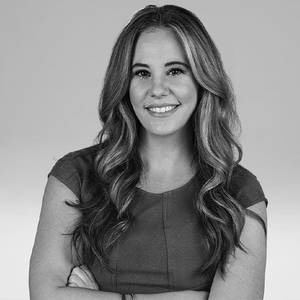
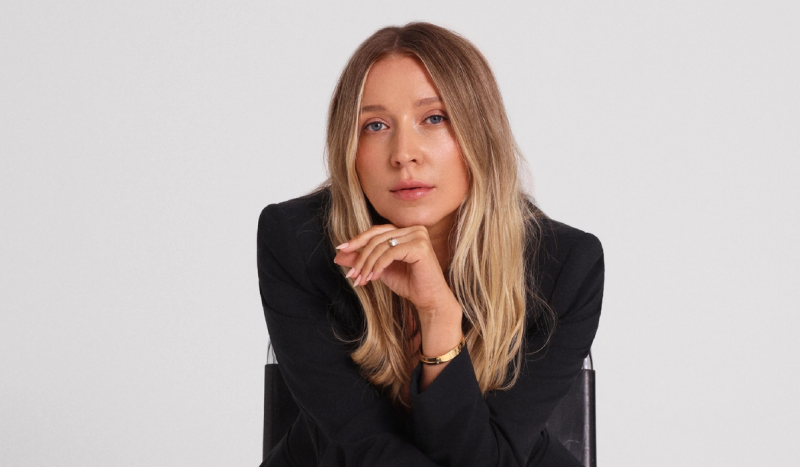
Meet Margarita Nazarenko—entrepreneur, lifestyle creator and the charismatic voice behind the wildly popular Being Her podcast. On September 1, she brings her signature blend of warmth and no-nonsense wisdom to the page with her debut book, Unbothered: The Art of Letting Go to Find Yourself. Part psychology, part permission slip, the book reframes letting go not as coldness but as a form of strength, guiding readers away from over-functioning in relationships and toward peace, grace and a steadier sense of self. Already a runaway success since its May release in Australia, Unbothered is poised to resonate with anyone ready to stop chasing potential and start choosing themselves.
Ahead, our conversation with Nazarenko on letting go of beauty standards, nervous-system-regulating rituals and protecting her identity while building a public platform.
Your book reframes ‘letting go’ as a strength rather than coldness. Has this mindset shift changed how you approach your beauty and self-care routine? Do you find yourself letting go of certain rituals or standards, too?
“I think peace exists on the other side of letting go of expectations and the belief that you can control how other people perceive you. That has definitely changed the way I approach beauty.
I grew up with an Eastern European mother, so self-beautification was very much celebrated. Makeup, presentation and not even taking the rubbish out without putting a little something on your face was completely normal in our house. It is still something I value and enjoy.
At the same time, letting go of other people’s expectations has made me really relish beautiful makeup-free days. At 38, I am actually finding myself more beautiful with less covering my face. I am leaning much more into skin care, caring for myself from within and accepting my face as it is, rather than constantly trying to improve or disguise it.”
You talk a lot about nervous system regulation over just setting boundaries. Do you have any physical or beauty-adjacent rituals, such as skin care, movement or breathwork, that help you regulate in real time?
“As ironic as it sounds, one of the most effective things for me is walking 10,000 steps alone. No friend, no phone call, no podcast. Just being inside your own mind and allowing yourself to reflect or even become a little bored.
I am currently building some new systems and masterclasses for my website, and when I included this, my Gen-Z team told me that walking 10,000 steps sounded too generic. But I genuinely think it is one of the biggest unlocks.
Walking supports lymphatic drainage, gives your mind space to think and helps bring your cortisol down. Once that noise settles, you can actually hear your own body again. After a long walk, I can suddenly tell whether I am thirsty, tired, hungry or simply overwhelmed. We are often so overstimulated that we lose the ability to hear what our own system is asking for.”
Being Her has built such a loyal following around authenticity and self-work. Has doing the podcast changed the way you think about your own image, specifically what you are willing to show versus curate?
“Before I had such a large audience, I was mostly focused on creating a space for women, sharing useful ideas and delivering those very direct truth-bomb moments that tend to travel online.
As the audience has grown, people have naturally become more interested in me personally, my family, my children and the reality of my life. There is always a part of me that wants to share everything, because I am a very open person, but there is also a responsibility to keep certain things private.
I have realized that the best way for me to exist online is to be useful. The moment everything becomes entirely about me, I think it becomes a little less beneficial. I can be authentic without making every part of my life public.”
The book was already a hit in Australia before this U.S. release. Did anything surprise you about how different audiences responded to the idea of choosing peace over potential?
“What surprised me most was how many women seemed to be waiting for permission to choose themselves.
Obviously, I am no one to give another woman permission to live her life, but sometimes people need to hear a different way of framing something. So many women are focused on another person’s potential, who they could become, how the relationship could change or what might happen if they just try a little harder.
The idea that you can stop focusing on changing someone else and start choosing your own peace was the reframe many women needed. It was not about giving up. It was about recognizing that peace is also a valid ambition.”
A lot of your message is about women who over-function in relationships. Do you see a parallel with how women over-function with their appearance, chasing an idealized standard instead of what actually feels good?
“Absolutely. Women are placed in an impossible position when it comes to beauty.
If a woman maximizes her beauty, enjoys makeup or cares deeply about her appearance, she is called vain, shallow or a bimbo, and her intelligence is often questioned. If she stops prioritizing her appearance, she is told she has let herself go, become mumsy, aged too quickly or failed to maintain herself.
There is no obvious way to win, which is why I think women have to stop playing for approval. Be disagreeable.
I believe there is power in self-mastery, and I actually think vanity can be reclaimed as a power move rather than treated as an insult. Wanting to feel beautiful does not make a woman unintelligent or unserious.
Women often over-function by constantly trying to please everyone around them. Sometimes the most useful thing you can do is tell everyone to get lost, put on a face mask and do something entirely for yourself.”
If Unbothered is about finding yourself outside of other people’s expectations, what does that look like for you personally when it comes to beauty? Is there a goal or standard you have let go of?
“I will be vulnerable and say that the biggest standards I have had to let go of relate to my body and my weight.
I came from pageants, television, acting and modeling, where there were very specific expectations around appearance, particularly around being slim. When you spend years telling your body exactly what size it is allowed to be, I think eventually it begins to rebel.
As I have moved through my thirties, I have had to let go of the idea that I need to conform to one global version of what a beautiful woman is supposed to look like. Even the current pressure to train for a very specific body shape, the tiny waist and the perfect peachy gym body, is still another standard women are being asked to meet.
My butt is an average butt. That is also okay.
Beauty has become less about forcing myself into a trend and more about accepting the body and face I actually have.”
You’re an entrepreneur, podcaster and now author, all public roles. How do you protect your own identity when so much of your life is content?
“I have realized that what makes me powerful online is my ability to relate to women from the point of view of where I genuinely stand. That does not require me to share every detail of my personal relationship, my children or where I live.
In fact, before I had the career I have now, I sometimes tried to share more of my private life, and it felt far too vulnerable and exposed. I eventually realized that it was neither desired nor required.
I think online platforms can be incredibly powerful for women, particularly women who are at home with children and want to build a career that allows them to remain present in their own lives. The internet can become a genuine source of income, independence and flexibility, while still allowing you to be useful and create something meaningful.
It does not have to be relationship advice. That just happens to be my area. It could be anything from making muffins to styling clothes. You can share what you know without turning your entire private life into content.”