Weight loss on GLP-1 medications has been widely covered as a metabolic and lifestyle shift, but for many patients, the story doesn't end once the number on the scale drops. According to NewBeauty’s Q2 2026 State of Aesthetics report survey of GLP-1 users, loose or sagging skin emerged as the most commonly named concern after weight loss, cited by 42 percent of respondents.
Ahead, four plastic surgeons explain how they’re addressing skin laxity after GLP-1 weight loss, why timing matters and when surgery may be the better option.
Featured Experts
- Joseph A. Russo, MD is a board-certified plastic surgeon in Newton Centre, MA
- Daniel A. Hatef, MD is a board-certified plastic surgeon in Nashville, TN
- Ruth Hillelson, MD is a board-certified plastic surgeon in Richmond, VA
- Peter D. Geldner, MD is a board-certified plastic surgeon in Chicago
The Scale of the Shift
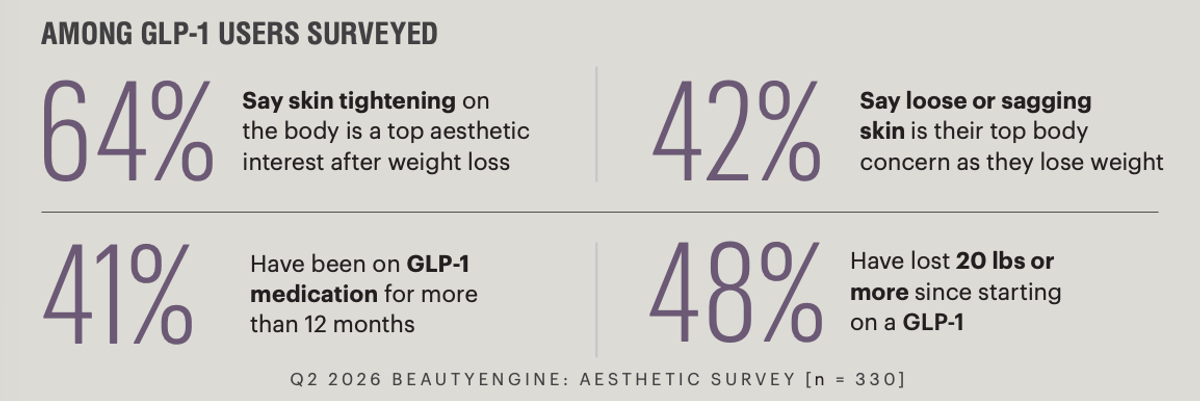
Nearly half of respondents, 48 percent, have already lost 20 pounds or more since starting a GLP-1 medication—enough for the physical changes to become noticeable. Newton Centre, MA plastic surgeon Joseph A. Russo, MD, a member of NewBeauty’s Brain Trust, says the numbers track with what he is seeing in his own practice. "Skin laxity has become a major concern for many GLP-1 patients after significant weight loss,” he says. “It has driven an increased number of surgical procedures, but also a very significant number of skin tightening, biostimulators, skin care and devices to maintain muscle mass.”
Skin tightening on the body is now the top aesthetic interest for 64 percent of GLP-1 users surveyed. Chicago plastic surgeon Peter D. Geldner, MD says, “Roughly one in eight adult Americans is taking GLP-1 agonists.” Regardless of their goals, he says, “Every large weight loss results in loose skin.”
Among respondents’ biggest concerns after weight loss, muscle tone followed loose or sagging skin closely at 40.4 percent, with excess body fat and cellulite ranking behind it. The degree of laxity varies by patient, Dr. Geldner notes, shaped by age, hormonal status, skin moisture, sun exposure and genetics. In his practice, this is translating into requests ranging from breast lifts and abdominoplasties to facelifts and arm lifts.

Nonsurgical Options Are Having a Moment
For patients who want to avoid the operating room, Dr. Russo points to noninvasive treatments. “HA fillers, biostimulators, and energy-based treatments like radio frequency and ultrasound, and laser all have a role,” he says, noting that newer technologies like ellacor and alloClae, a structural adipose tissue product designed for aesthetic body procedures, have also shown promise in addressing skin laxity.
Richmond, VA, plastic surgeon Ruth Hillelson, MD, is seeing the same demand. “Skin laxity as well as crepiness have become more frequently requested consults in my practice,” she says. Her approach pairs radiofrequency treatments with her Iridesse topicals while patients are still losing weight. “Ongoing weight loss laxity does well with RF,” she says, “since surgery would not be an option until weight has stabilized.”
But Timing Is Everything
Dr. Geldner is especially firm on this point. “I always advise the patients to achieve their chosen weight before undergoing surgery,” he says. “To have skin reduction procedures before weight loss medication is a poor idea." He's also blunt about the ceiling on nonsurgical results: “Unfortunately, there are no reliable skin-tightening options that achieve the skin tightening of surgical excisions.”
Different Patients, Different Playbooks
Not every provider takes the same approach. Nashville, TN plastic surgeon Daniel A. Hatef, MD, often tells patients with significant laxity who are still actively taking a GLP-1 to slow down rather than move forward with surgery. “I let them know that their body is telling them it is time to slow down and stabilize at a slightly higher weight,” he says. His practice offers medical weight-loss management to help patients do so or coordinates with the patient’s prescribing physician. “Sometimes this is received well,” he says, “and other times we do not see the patient again.”
Why Prevention Matters
Several of the doctors emphasize that prevention may be easier than correction. “The best way to minimize or perhaps even prevent skin laxity is to be proactive,” Dr. Russo says. “It is much easier to prevent it than to treat it once it has happened.” For Dr. Russo, that means starting biostimulators, a skin-care regimen and energy-based treatments before weight loss begins, along with a high-protein diet and muscle-building work, “using devices like Sofwave’s Pure Impact VIP.”
Dr. Geldner also recommends good skin care, sun avoidance and a slower pace of weight loss. “The best advice I can give any patient currently losing weight with GLP-1 agonists is to practice good quality skin care with the help of an aesthetician, avoid sun exposure and go slow with the weight loss,” he says.