As skin-care education becomes more widespread online, one clinical term keeps surfacing on our feeds: the Fitzpatrick scale. Yet despite its growing visibility, this decades-old classification system remains widely misunderstood outside of dermatology offices.
Here, top derms break down exactly what the Fitzpatrick scale is and how it’s used to guide treatment decisions in-office.
What is the Fitzpatrick scale?
“The Fitzpatrick scale is a pigmentation classification system that allows skin-care professionals to categorize skin shades, predisposition to sunburn, sun damage and skin cancer risks for patients,” explains Davie, FL dermatologist Marianna Blyumin-Karasik, MD. “This is based on scientific evidence that lighter skin shades have higher UV (ultraviolet) radiation damage predisposition and darker skin tones have higher skin resilience against this damage due to their naturally higher concentration and type of melanin. Melanin absorbs UV light and oxidative stress on the skin’s surface and protects against the sun’s damaging rays. Interestingly, in darker-toned individuals this translates to not only lower skin cancer risks, but also more skin endurance and delayed photoaging, such as wrinkles and skin laxity.”
New York dermatologist Elaine Kung, MD says the scale is named after Dr. Thomas B. Fitzpatrick, a longtime professor of dermatology at Harvard Medical School (he passed away in 2003 at the age of 83). Fitzpatrick developed the system in 1975 to classify fair skin by how it responds to the sun, from skin that always burns and never tans to skin that rarely burns and tans easily. Types V and VI, for darker skin, were added later and, Dr. Kung notes, “were more based on skin color rather than reactivity to the sun.”
What are the six different skin types on the Fitzpatrick scale?
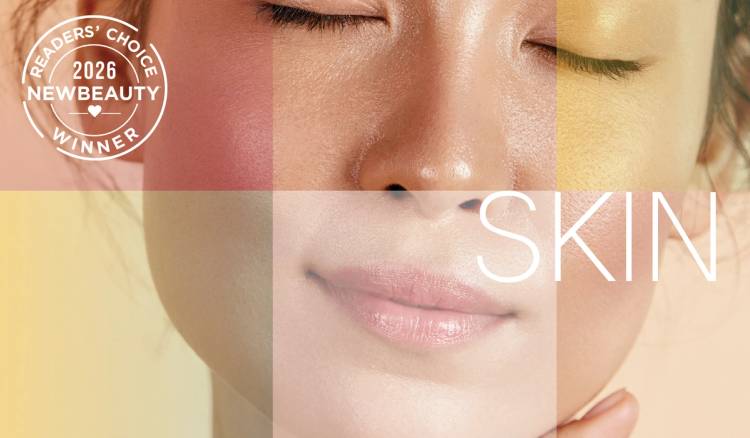
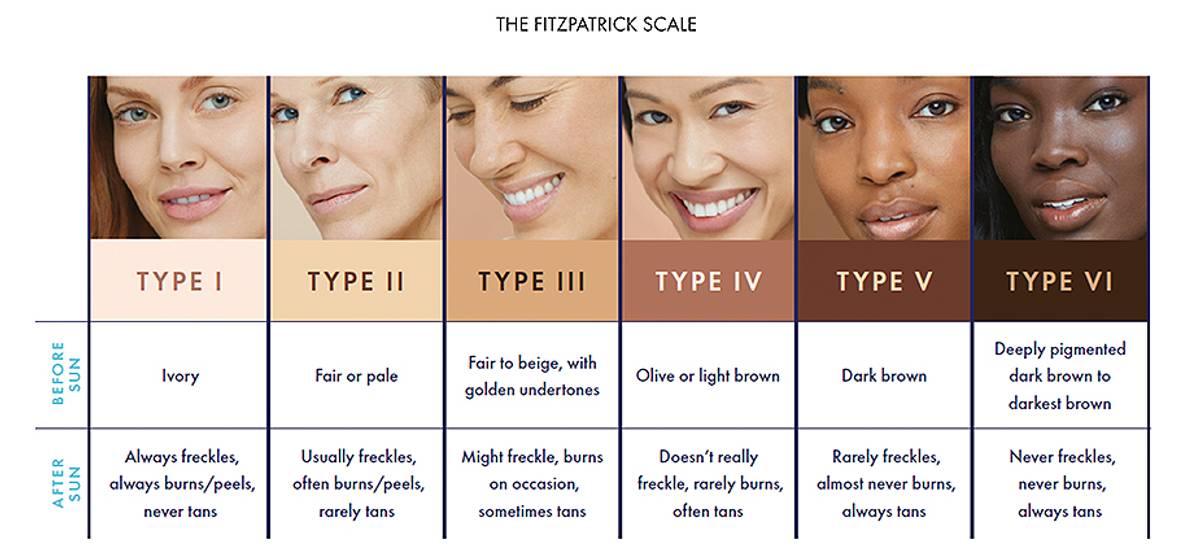
The Fitzpatrick scale grades skin color from type I to VI (light to dark). “So, skin types I and II, for example, are the palest tones, have more freckles and are easily prone to sunburn and photoaging,” says Dr. Blyumin-Karasik. “Meanwhile, types V and VI are the darkest, rarely sunburn and easily tan and have slower photoaging processes.” Olive complexions that tan easily typically fall into type IV. According to the American Academy of Dermatology, people with type I and II skin face the greatest risk of sun damage and skin cancer, making daily sun protection especially critical.
Fitzpatrick Type I:
Very light, pale white skin, often with red or blonde hair, light eyes and freckles. Always burns, never tans.
Fitzpatrick Type II:
White to fair skin, typically with blonde or red hair and light-colored eyes. Usually burns, tans minimally.
Fitzpatrick Type III:
Fair to beige skin tone with a range of eye and hair colors. Sometimes burns mildly, tans gradually and evenly.
Fitzpatrick Type IV:
Olive or light brown skin, often seen in Mediterranean, Hispanic, Asian or Native American backgrounds. Rarely burns, tans easily.
Fitzpatrick Type V:
Brown skin, common among Middle Eastern, South Asian and some Hispanic and Black populations. Very rarely burns, tans darkly with ease.
Fitzpatrick Type VI:
Deeply pigmented, dark brown to black skin. Never burns, tans very easily.
How do dermatologists use the Fitzpatrick scale?
Dermatologists still often use this phototyping system as a tool to determine their patients’ best skin management, says Dr. Blyumin-Karasik. “At our clinic, we often apply the Fitzpatrick scale to guide us with the optimal and safer mode of cosmetic treatments, such as chemical peels, microneedling and lasers. In general, for darker individuals with higher Fitzpatrick skin types (III and above) who are more prone to post-procedural skin pigmentation due to higher melanin concentration and reactive melanogenesis, it is very critical to choose more conservative treatment options and settings. Therefore, the aesthetic procedures with minimal melanogenesis risk, or less heat induction, mechanical abrasion and inflammation, are better cosmetic options for darker Fitzpatrick skin types.”
There are some in-office treatments, however, that Dr. Blyumin-Karasik says are friendly to all skin types, including “Hydrafacial for skin clarity and radiance, the PicoWay laser to even out skin tone and the UltraClear laser for skin resurfacing to smooth skin texture.”
Criticisms of the Fitzpatrick scale
Dr. Kung says the main criticism of Fitzpatrick skin classification is “the subjectiveness of phototyping based on questions that doctors ask regarding a patient’s skin reactivity to sun exposure for fairer-skinned people. On the other hand, people who are Northern Asian or Middle Eastern may automatically be classified as skin type III or IV, and Latin American or Southeast Asian may automatically be classified as skin type IV or V. African Americans may automatically be classified as V or VI based on ethnicity instead of skin reactivity to sun exposure.”
“Objective methods of skin typing, such as pigment protection factor and skin color measurement, have been developed, but they require spectroscopy or colorimetric analysis, which are not readily available or feasible in a clinic,” Dr. Kung adds. “Regardless, there is much more to classifying skin than just looking at its color. Genetic background and ethnicity play an important role. The level of eumelanin versus pheomelanin not only determines skin color, but also contributes to the level of ultraviolet or environmental stress protection.”