
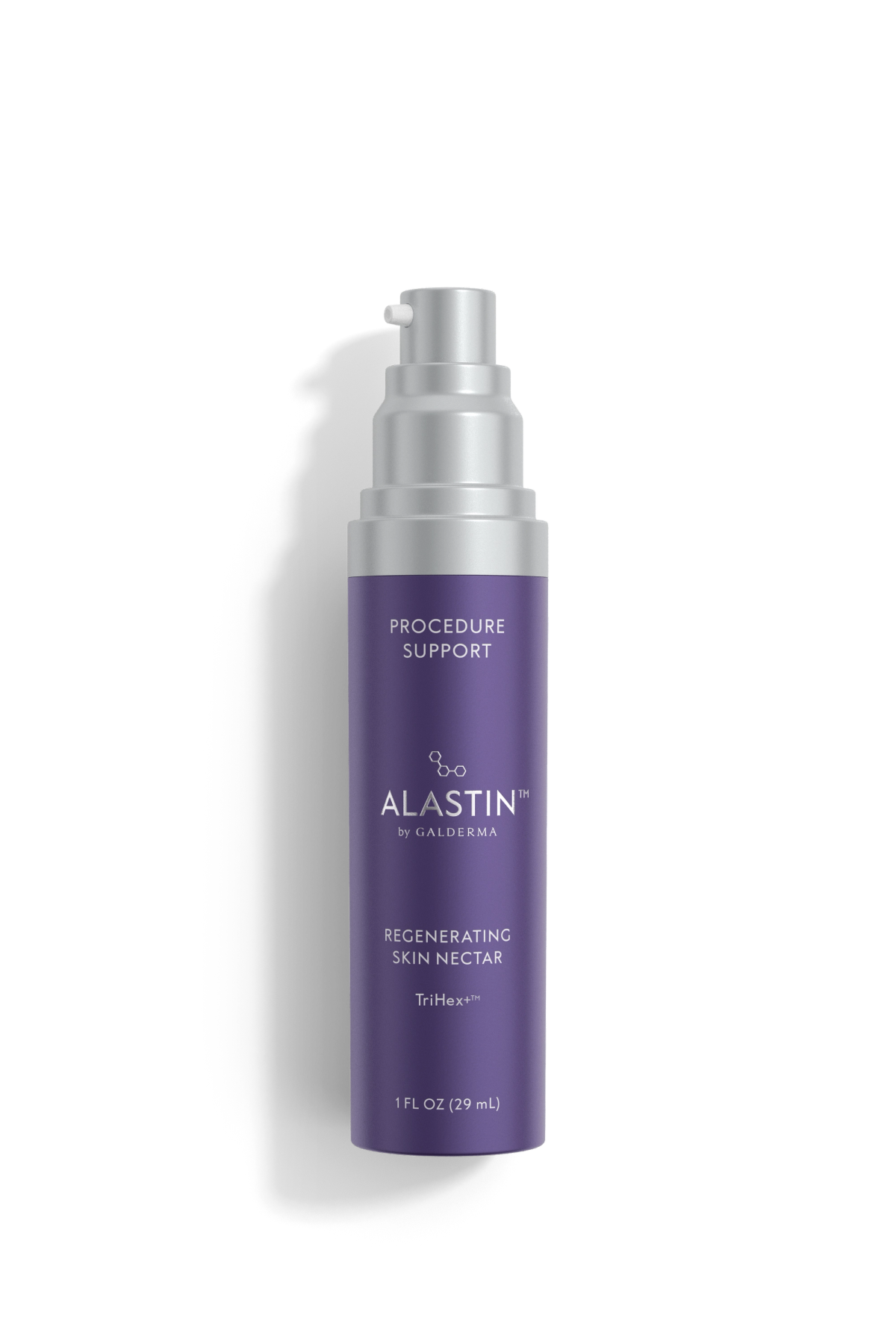
Alastin’s Skin Nectar has always been one of those in-office staples that sells itself. Once patients use it, they understand why it’s built into so many pre- and post-procedure protocols. Now it’s getting a meaningful upgrade and, if you’re paying attention to where skin care is heading, it tracks.
The reformulation centers on TriHex+ technology, the next evolution of the brand’s core peptide complex. At its foundation is a targeted approach to rebuilding the extracellular matrix, clearing out damaged collagen and elastin and signaling the skin to regenerate healthier structures in their place.
“We’ve been working on the foundation of the skin for years—collagen, elastin, hyaluronic acid—and finding a way to take damaged tissue and replace it with new tissue,” said chief scientific officer at Galderma and head of Alastin innovations, Alan Widgerow, MD, when we spoke at the American Academy of Dermatology Annual Meeting in Denver. “That’s the whole basis of TriHex technology, extracellular matrix modulation.”
What’s New
The biggest update is the addition of Octapeptide-45, designed to work alongside the original TriHex peptides. Together, they don’t just support collagen and elastin, they stimulate fibroblasts to produce high-molecular-weight hyaluronic acid within the skin.
“Low molecular weight hyaluronic acid is inflammatory. High molecular weight is anti-inflammatory,” Dr. Widgerow explained at AAD. “We’ve now got the fibroblast producing that high molecular weight hyaluronic acid inside the skin.”
Instead of layering HA on top of the skin, this approach pushes the skin to make its own, and the right kind. The result is more than hydration. It’s structural support, improved healing and greater overall skin resilience.
Why the Synergy Matters
This isn’t about adding another peptide for the sake of it. It’s about how the system works together.
“People think you just add another peptide,” Dr. Widgerow said. “But when you see the synergy, this is a significant advance.”
By stimulating collagen, elastin and high-molecular-weight HA at the same time, the formula targets the architecture of the skin, not just surface-level concerns.
Why Skin Quality Is So Important
Skin quality is having a moment, and not just because of the broader shift toward regenerative aesthetics. There’s also a new patient population driving demand: those on GLP-1 medications.
As rapid weight loss changes the face and body, patients are seeing shifts in skin laxity, texture and density. The conversation is moving beyond volume and into structure.
“We’re seeing it more and more with GLP-1 patients,” Dr. Widgerow told us at AAD. “It’s not just about replacing volume. It’s about restoring the quality of the skin itself and supporting it at a cellular level.”
He added that Alastin is already studying full protocols for these patients, looking at how skin-supporting topicals can work alongside in-office treatments. “We’re developing programs for the face, neck and body because these changes aren’t isolated. It’s a full-body shift.”
The Bottom Line
For a product that’s already deeply embedded in treatment protocols, this doesn’t feel like a reinvention. It feels like a smart evolution, one that aligns with where both the science and the patient conversation are going.